

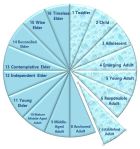
By this Blob, most adults are well established in their careers and personal lives. A routine often takes over, leading many established adults to reflect and reassess. They may find themselves asking, “Is this all there is to life?” and comparing their current selves to the person they thought they would become. It’s almost like ‘half-time,’ and this period can sometimes lead to a mid-life crisis, especially for women.
Psychologist Levinson’s refers to this stage as Midlife Transition, a critical juncture where individuals evaluate their achievements and contemplate future goals. It often involves a reassessment of values and priorities, paving the way for a deeper understanding of oneself. In Japan, many individuals in their late thirties or early forties experience ikigai reflection—a search for meaning and purpose in life. This might involve stepping back from a corporate role to start a fulfilling creative pursuit. This period can be marked by a desire to realign one’s life with personal passions or values that may have been neglected during the previous years of career building and family responsibilities. Many individuals use this time to make meaningful changes—whether that means shifting career paths, focusing on personal wellness, or strengthening relationships. It is also a time to acknowledge past successes and failures, which can foster a sense of growth and provide motivation for the future. Overall, this stage is about integrating past experiences to create a more authentic and fulfilling life moving forward.
The “Eleventh Hour Panic”
 Women who are still single or childless at this stage may experience what is often referred to as the “eleventh hour panic” as they become more aware of their biological clock. They face the decision to either remain childless or take extra measures to plan for children, now or in the future. Some companies, like Apple and Facebook, even cover the cost of elective egg freezing for female employees who choose to delay childbearing.
Both single men and women in this Blob might encounter uncomfortable questions from well-meaning friends and family about their ‘single’ status. According to Eurostat data from 2015, traditional nuclear families (a couple with children) are declining, with a significant proportion of adults choosing to live alone (31.4%) or as couples without children (24.7%).
Relationship Challenges and Divorce
For those who are married but feel dissatisfied, this period can bring restlessness and depression. Many may feel they are still relatively young, with time to make a fresh start, especially if they are still within childbearing age. As a result, divorces during this Blob are not uncommon, and increasingly, they are initiated by women. Divorce brings about significant change and often a temporary financial and social crisis that must be navigated. Eurostat statistics indicate that lone parent families account for 16% of all families in the EU-28 region, with the majority being led by lone mothers (13.4%).
The “Last Child” Consideration
On the other hand, there are also many happily married, settled couples who might be contemplating having a ‘last child.’ Their approach has often become more practical, as they juggle the demands of family life and the need to make important career and personal decisions. Success at work is still a priority, but so are fulfilling social responsibilities. Activities related to their children’s schooling can take up a significant amount of time and energy. Meanwhile, relationships with their own parents may start to shift as they reach retirement age, adding another layer of responsibility.
Physical and Mental Changes
During this Blob, signs of aging become more noticeable. Skin may become drier, wrinkles start to appear, and hair continues to gray. Many women may experience pre-menopause, leading to hormonal imbalances and fluctuations. This can manifest as changes in weight distribution without any significant change in diet, sleep disturbances, hair loss, vaginal dryness, shifts in libido, irregular periods, and other side effects.
Mentally, pre-menopause may bring anxiety, mood swings, or a sense of urgency as women notice these physical changes even though they still feel young at heart.
Have you found yourself re-evaluating your life in your late 30s or early 40s? What changes did you make?
Download your Life Stages in Blobs Worksheet now and start your journey!
Click here for Blob 8: Anchored Adult
or read about any other Blob:
Spring: 1-6, 7-12, 13-18, 19-24
Summer: 25-30, 31-36, 37-42, 43-48
Autumn: 49-54, 55-60, 61-66, 67-72
Winter: 73-78, 79-84, 85-91, 91-…
Understand why the 7-year life stages are outdated in this Blog
RESOURCES AND REFERENCES
Apple and Facebook offer to freeze eggs for female employees from The Guardian
Being young in Europe today – family and society from Eurostat Statistics
People in the EU – statistics on household and family structures from Eurostat Statistics
You’re Turning 40-Embracing Both Physical and Emotional Changes at this Milestone Birthday by Deb Schilling (Family Medicine, Primary Care)

 Life Stages in Six-Year Blobs – Personal Growth by Age