

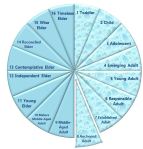
By this Blob, most adults have reached a point where they feel anchored, knowing where they stand in life—assuming any mid-life crisis from previous stages hasn’t drastically altered their world.
Individuals often strive to contribute to the broader community and create a lasting impact. Psychologist Erikson’s emphasizes in this Generativity vs. Stagnation stage the importance of nurturing others, whether through parenting, mentorship, or community involvement. For example, in Mexico, midlife growth often involves mentorship within extended families or communities. Sharing knowledge with younger generations reinforces cultural continuity and fosters a sense of accomplishment. Many people during this period focus on giving back, either by guiding the younger generation, volunteering, or applying their skills in meaningful ways. It is also a time for expanding one’s influence, pursuing projects or causes that matter deeply, and finding fulfilment in making a positive difference. Successful generativity leads to a strong sense of accomplishment, purpose, and connection, reinforcing the belief that one’s contributions truly matter. On the other hand, if individuals feel unable to contribute meaningfully, they may experience stagnation, which can lead to feelings of unproductiveness or dissatisfaction.
Career and Intellectual Development
For those actively working, this is a time of high productivity, benefiting from a balance of experience and intellectual ability. Many receive recognition for their achievements and may reach middle or upper management levels. For those in secure jobs, this stage can mark the beginning of a ‘maintenance phase’ in their careers.
Towards the end of this Blob, fluid intelligence—the capacity to solve new problems without prior knowledge—may begin to decline, along with intellectual abilities that depend on speed. Some may also notice a slight slowdown in short-term memory processing. However, crystallized intelligence—the ability to apply skills, knowledge, and experience—continues to grow, often compensating for these changes.
For parents who took a break from their careers, this stage may be the time to return to work or even pursue new studies to start a different vocation. However, time pressures often limit social activities as careers, children, and other social responsibilities take priority. Additionally, aging parents may require more attention due to health issues.
Physical Changes and Social Perceptions
Physically, most people begin to notice difficulty in seeing objects closer than 2 feet, a condition called presbyopia. This happens as the lens of the eye stiffens, often requiring reading glasses. Wrinkles and gray hair become more prominent, and changes in body composition may lead to an increase in fat around the stomach, commonly known as middle-age spread. Physical capabilities begin to decline, and the immune system becomes less effective at fighting off illness.
Society’s unrealistic expectations for women to maintain a youthful appearance can lead to psychological challenges. Meanwhile, men may often be seen as more “sexy and mature” as they age, a disparity that is also reflected on online dating platforms. Research shows that men’s desirability peaks in their late 40s, while women’s peaks at age 21.
Accepting Finite Time and Seeking Purpose
With the half-century mark approaching, anchored adults begin to accept that time is finite, often feeling a sense of urgency to make a meaningful impact. Some might start writing the book they’ve always dreamed of, while others (like myself!) may begin a blog. Still, others might become more active in social causes, seeking to make a difference in their community.
How have you felt about turning 45? Have you taken on any new projects or passions?
Download your Life Stages in Blobs Worksheet now and start your journey!
Click here for Blob 9: Middle-Aged Adult
or read about any other Blob:
Spring: 1-6, 7-12, 13-18, 19-24
Summer: 25-30, 31-36, 37-42, 43-48
Autumn: 49-54, 55-60, 61-66, 67-72
Winter: 73-78, 79-84, 85-91, 91-…
Understand why the 7-year life stages are outdated in this Blog
RESOURCES AND REFERENCES
Fluid and crystallized intelligence from Wikipedia
What Do You Really Know About Online Dating? from Psychology Today
A New Kind of Midlife Crisis for Women — From Sea Turtles to Social Work from Huffington Post

 Life Stages in Six-Year Blobs – Personal Growth by Age