
 Traditionally, this Blob has been seen as the beginning of old age, marking the transition from ‘work-life’ to ‘retirement.’ But today, members of this age group are different from previous generations. In a special report on longevity, The Economist explored various names for this age group, suggesting labels like “Geriactives,” “Sunsetters,” “Nyppies” (Not Yet Past It), and “Owls” (Older, Working Less, Still earning). Yet, none seem to fully capture the spirit of this new generation of Young Elders.
Preparing for Retirement and Generativity
As they approach retirement, many begin making plans for the next stage of life. Erik Erikson’s theory of Generativity—a concern for guiding and nurturing the next generation—often emerges during this period, rooted in a sense of optimism about humanity. This can lead to a strong desire to mentor younger people and leave a lasting impact.
The traditional retirement age of 65 was established by Otto von Bismarck in the 1880s, at a time when the average life expectancy in Prussia was just 45. Today, the average life expectancy in OECD countries is in the early 80s, yet many nations still adhere to 65 as the standard retirement age. This doesn’t account for the fact that 90% of 65-year-olds are usually in good health, with half of the next 20 years expected to be free of disability.
With life expectancies now stretching into the 90s, the traditional retirement age of 65 may not be financially feasible for everyone. Savings might need to be supplemented to sustain the next 30+ years. For some, this could mean exploring post-retirement employment options. While a few may continue in the same industry, many others may need to learn new skills and pursue vocations that demand less physical or mental exertion.
Reinventing Retirement
Many Young Elders cannot afford, or do not want, to retire completely. Instead, they seek financial security with more flexibility. For them, this period is about re-creation rather than recreation. As described in the thought-provoking book The 100-Year Life: Living and Working in an Age of Longevity—shortlisted for the Financial Times’ “Business Book of the Year” in 2016—people are redefining what it means to grow older.
In some professions, there is no natural retirement age, allowing politicians, business leaders, and artists to stay active well beyond the traditional retirement age. For others, this might be the time to learn new skills, re-enter the workforce, or use their maturity and experience to offer coaching and consulting services. Many Young Elders are also tapping into platforms like Airbnb as a source of income; they are the fastest-growing group of hosts and receive some of the highest ratings.
Navigating Change
For many, life changes dramatically towards the end of this Blob. Retirement—whether self-imposed or due to a spouse retiring—brings significant shifts in routines and relationships. Some Young Elders look back with satisfaction, feeling content with their achievements, while others may experience a sense of regret. This period becomes a time for reflection on how to proceed in the coming years.
Some may decide to take it easy, focusing on hobbies, socializing, and spending time with grandchildren, while others may seek alternative sources of income. Either way, they remain strong contributors to the economy. According to McKinsey, 59% of consumption growth in cities between now and 2030 will come from those over 60.
Life Expectancy and Health
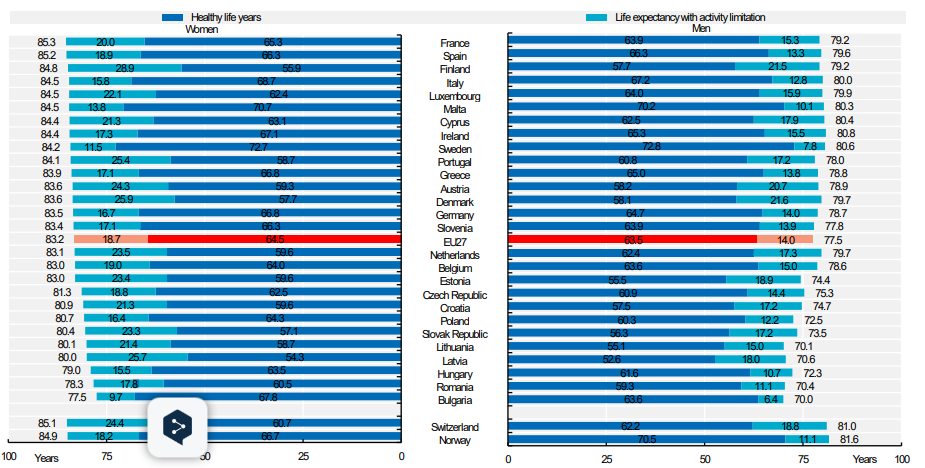
Life expectancy at age 65 in the EU-28 states averages 18 years for men and 21 years for women, though with some limitations in activity. Researchers now differentiate between active life expectancy (adding life to years) and dependent life expectancy (adding years to life). Improvements in living standards and medical advancements are steadily increasing these figures. While lifestyle choices play a significant role in longevity, genetic, environmental, ethnic, and gender factors are also influential.
Studies suggest a correlation between body weight and life expectancy. According to research by Yang in 2008, individuals with a normal body weight at age 65 have a longer life expectancy compared to those who are overweight.
Physical Changes
Physically, the body continues to show signs of aging, and health issues may become more prevalent. Skin wrinkles deepen, and the senses of smell and taste may diminish. Approximately one-third of people over 65 experience hearing loss, particularly in distinguishing between high and low frequencies. By this age, adults need 20% fewer calories than in their youth, but the need for nutrients remains the same, often leading to situations where elders are overweight but undernourished. This makes the use of supplements and regular medication common. On the upside, many may notice they become less sensitive to pain as they age.
Mental Health and Cognitive Changes
Mentally, the loss of brain volume that begins in the 50s becomes more pronounced in the 60s, leading to noticeable cognitive changes. According to a report from Johns Hopkins Health Alert, it becomes harder to learn new information or master complex tasks, and focusing without distraction can be more challenging. Memory retrieval and the ability to build on existing information may also decline.
Embracing the Role of Young Elder
Young Elders today are redefining what it means to age. Whether by continuing to work, learning new skills, or embracing hobbies and social activities, this generation remains engaged and vital. They have the opportunity to reshape what the next decades of life can look like, making the most of their experiences, health, and resources.
How do you plan to navigate your 60s? What hobbies or skills are you excited to explore?
Download your Life Stages in Blobs Worksheet now and start your journey!
Click here for Blob 12: Independent Elder
or read about any other Blob:
Spring: 1-6, 7-12, 13-18, 19-24
Summer: 25-30, 31-36, 37-42, 43-48
Autumn: 49-54, 55-60, 61-66, 67-72
Winter: 73-78, 79-84, 85-91, 91-…
Understand why the 7-year life stages are outdated in this Blog.
RESOURCES AND REFERENCES
The 100 year life- living and working in an age of longevity by Lynda Gratton and Andrew Scott
The Economist Special Report: The new Old
Life expectancy at age 65, 1980–2013 from Eurostat Statistics
Healthy life years statistics from the OECD Library
CliffsQuickReview Developmental Psychology
Your memory Timeline by Johns Hopkins Health Alert for Maturity Matters
The Financial Burden of Overweight and Obesity among Elderly Americans: The Dynamics of Weight, Longevity, and Health Care Cost by Zhou Yang and Allyson G Hall

 Life Stages in Six-Year Blobs – Personal Growth by Age