
Understanding Life Stages in Six-Year “Blobs”
Blobs represent the seasons of life, thoughtfully divided into six-year stages to encourage reflection and self-discovery. While life’s milestones and transitions rarely follow exact timelines, this framework serves as a guide to understanding common patterns and challenges. Use it as a tool to explore your journey, adapt it to your unique path, and embrace opportunities for growth along the way.
In easy-to-digest 6-year segments, Blobs describe a journey that is typical for someone living in today’s middle-class society in the developed world, and to some extent, the wealthier, urban society in developing countries. Each Blob represents a learning phase where we develop new skills and abilities. Through this framework, I hope to help you better understand not just yourself, but also your partner, children, parents, friends, and social circle.
Download your Life Stages in Blobs Worksheet now and start your journey!
(Read also my blog post on why the ancient 7-year life cycle model needs to be adapted to today’s lifestyle).
What are the Six-Year Blobs?
Blobs of Six divide the human lifespan into four seasons, each spanning 24 years. Every season is then broken down into four Blobs of 6 years each:
- Spring (1-24 years): Developing, Absorbing and Growing
- Summer (25-48 years): Engaging, Executing and Maturing
- Autumn (49-72 years): Stabilizing, Harvesting and Giving
- Winter (73 years and beyond): Slowing down, Reflecting and Releasing
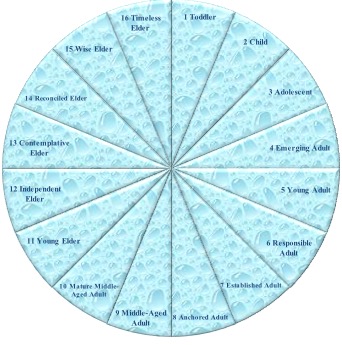
I like to think of “Blobs” as droplets of life—a continuous sequence that makes up a lifetime. Each person is a unique blend of all the Blobs they’ve experienced.
From birth, we grow into children, enter puberty, progress to adulthood, transition into old age, and eventually reach the end of life. Unless cut short, everyone follows this pattern, passing through these universal stages. In each Blob, we undergo a range of changes—biological, cognitive, psychological, moral, and social. We engage with our environment, learning and growing even into late old age. At the same time, we contribute back, taking on responsibilities and fulfilling our social roles.
Society, in turn, has its own expectations of us at each stage of life. These expectations vary depending on where you are, your culture, the time period, your economic situation, and educational background.
Being “On-Time”: Navigating the Blobs
The Blob framework outlines what you might typically experience at each stage of life, if you have been following a common pattern. Of course, everyone grows at their own pace and experiences life uniquely. Blobs aren’t meant to be rigid rules with strict boundaries. Not everyone will experience all the characteristics of a Blob, and there’s no need to “check off” every milestone before moving on to the next stage.
That said, life can sometimes feel “easier” if the skills meant to be developed in a particular Blob are acquired before moving forward. For example, a child generally learns to crawl before walking, and babbles before forming sentences. According to Bernice Neugarten’s social clock theory, those who reach milestones “on-time” are often more accepted by society and may lead less stressful lives compared to those who are “off-time” or experience unexpected milestones. For instance, a teenage mother might face more challenges fitting in than someone who has a child at a similar age to their peers.
However, experiencing milestones “off-time” doesn’t mean you’ll be any less happy. It simply suggests that the pattern has been broken, and you might have to navigate a different path to meet society’s expectations or find your own sense of belonging.
Have you ever felt ‘off-time’ with society’s expectations? Share your story in the comments below!

Forces Shaping Each Blob
During each Blob, several developmental forces are at play. These include:
- Biological Influences: Predictable changes such as puberty, graying hair, or loss of hearing.
- Environmental Influences: Events that affect large groups of people, like technological revolutions or wars.
- Non-Normative Influences: Unpredictable factors that impact only a few, such as birth defects, diseases, or personal life events.
These influences can either reinforce or disrupt the expected pattern of a Blob. For instance, a birth defect or illness may delay or cause someone to skip milestones, while other influences may accelerate events—such as a child prodigy finishing school early or someone choosing to marry at a younger age. Life events like divorce, disease, death, or prolonged stress can serve as turning points, leading to outcomes that differ from the typical Blob trajectory.
Fluidity and Flexibility, Especially in Later Years
Although Blobs describe common skills and patterns tied to specific ages, they are not rigid—especially as you grow older. The older you get, the more fluid these stages become. As Gail Sheehy explains in her book New Passages, over time, factors like genetics, gender, race, class, marital status, income, and health choices (or neglect) accumulate to make our paths more distinct from each other.
What Blob are you currently in? Do these descriptions resonate with your life experience?
Read about how Life Begins
or read about any other Blob:
Spring: 1-6, 7-12, 13-18, 19-24
Summer: 25-30, 31-36, 37-42, 43-48
Autumn: 49-54, 55-60, 61-66, 67-72
Winter: 73-78, 79-84, 85-91, 91-…
Understand why the 7-year life stages are outdated in this Blog

 Life Stages in Six-Year Blobs – Personal Growth by Age
Loved it. Aur batao. Aur batao 🙂
LikeLike
I find the name of some of your “blobs” interesting, especially the Timeless Elder. She is 105, and still mentally sharp. Alas, she is also very frail and not in the best health. It is a fascinating experience being with her. We only get to see her twice a year or so, given she lives 150 miles away and, if we want to see her, we have to bring her 89 year old sister in law (my mother in law) with her. But timeless as a description? Yes.
LikeLiked by 1 person
It’s interesting how 89 all of a sudden sounds young when you are talking of a 105 year old 🙂
LikeLike
Blob? Yes, sometimes I feel like a blob. Glad to know that I’m still in the Autumn part of the blog and not the Winter
LikeLiked by 1 person
Autumn is the best time :). But don’t be afraid of the winter! It holds many joys too.
LikeLike
I really enjoy this 6 year blob concept. I am sure I will be thinking about it for a while. Also thrilled that I am still a summer.
LikeLiked by 1 person
Hi admin, i must say you have high quality articles here.
Your blog should go viral. You need initial traffic only.
How to get it? Search for; Mertiso’s tips go viral
LikeLike