
You’ve probably heard of the “7-year itch.” Maybe you’re also familiar with the idea that our body renews all its cells every 7 years, the 7-year Chakras from Vedic India, the ancient Greek life cycles, or the Waldorf theories from Rudolf Steiner, the anthroposophist. Perhaps you’re wondering, “Is there any truth behind these 7-year cycles?” or “Do they still apply to our lives today?”
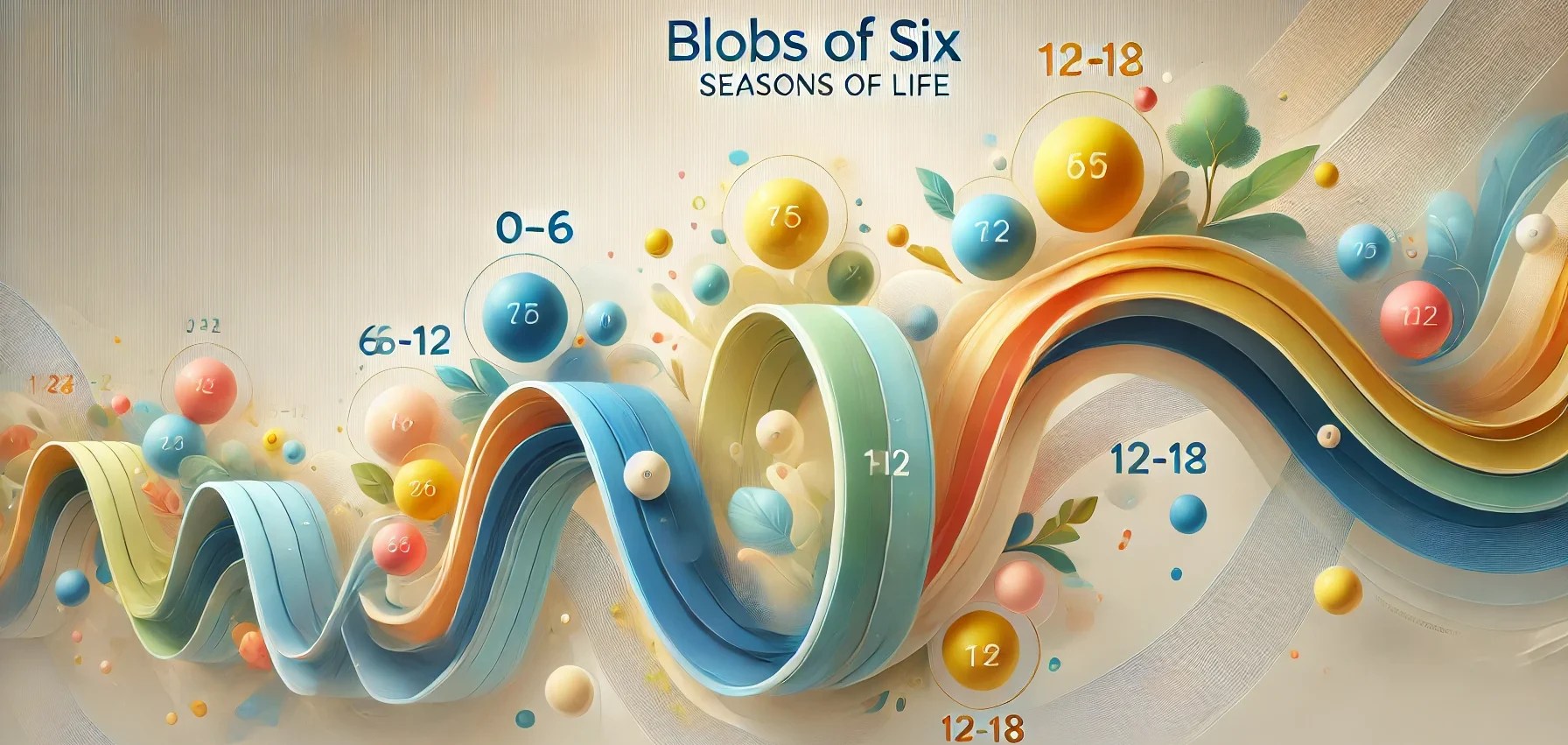
Read on to see why these traditional cycles might be outdated and how Blobs of 6-year stages, bundled into the seasons of Spring (growing), Summer (maturing), Autumn (harvesting), and Winter (releasing), better mirror our lives in today’s world.
Does Our Body Renew Itself Every 7 Years?
Let’s start by dispelling this myth: the belief that the body and mind renew themselves every 7 years is simply not true. Sure, our cells are constantly renewing, but at different rates. According to The New York Public Library’s Science Desk Reference (Stonesong Press, 1995), red blood cells replace themselves every four months; white blood cells renew every 2-3 weeks. Colon cells live only 4 days, and sperm cells just 3! Skin cells last 2-3 weeks, while brain cells remain for life—neurons don’t regenerate. While we do undergo many changes over 7 years, similar shifts can happen over 5 years, 10 years, or even just 2 years. Scientifically, there’s no basis for the “7-year renewal” belief.
Is the 7-Year Itch Real?
 The idea of the “7-year itch” was popularized by the 1955 Marilyn Monroe movie of the same name, which suggested marriages start facing trouble around the 7-year mark. While it’s true that this period can be challenging, as couples often have less time for each other while raising young children, data shows that the 7-year mark is just an average.
Research by Dr. Larry A. Kurdek, a psychology professor from Wright State University, found that marital quality often declines after 4 years, with many divorces occurring around this time. A 2010 study by Grant Thornton revealed that most marriages fall apart around the 12-year mark, while another study in 2012 pointed to a dip around 3 years, citing that many couples now get together later in life without enough time to know each other before having children. So, once again, there’s no solid evidence for a recurring 7-year itch.
Are 7-Year Life Cycles Keeping Up with Our Changing Lifestyles?
Rudolf Steiner, the founder of Anthroposophy and the Waldorf school concept, described life stages in 7-year intervals back in 1924. Many modern 7-year cycle models are still based on his theories. However, human life has changed dramatically since then. Thanks to medical advances, people are living much longer, which has reshaped how we experience different stages of life.
Here’s how the 7-year life stages tend to miss important milestones that are more accurately captured by the 6-year Blobs:
The Spring Season (1-24 years) vs. Steiner’s Early Stages
- Steiner’s 0-7 years vs. the 1st Blob (1-6 years): In most OECD countries, schooling starts at around age 6 (sometimes even 5), marking the end of the toddler years around that age.
- Steiner’s 14-21 vs. the 3rd Blob (13-18 years): Today, puberty and teenage years are seen as the 13-18/19 age range, with most teens finishing high school around 18. With longer educational periods, the learning years extend well beyond age 21, often into the mid-20s. This is captured in the 4th Blob of Spring: The Emerging Adult (19-24 years).
The Summer Season (25-48 years) vs. Steiner’s “Sun” Stages
Steiner’s next three stages (21-28; 28-35; 35-42) reflect adult working years, where play turns into responsibility. But the Summer Season of the 6-year Blobs (25-48) spans a broader range, reflecting the shift in today’s productive working years.
- Steiner’s 21-28 vs. the 4th and 5th Blobs (19-24 & 25-30 years): Steiner’s model misses the trend of Emerging Adulthood (19-24 years). In this age group, people no longer see themselves as adolescents, but many also don’t feel ready to fully embrace adult responsibilities like financial independence or long-term commitments. These are increasingly postponed, aligning with the 1st Blob of Summer: Young Adult (25-30 years).
Extending into the Autumn Season (49-72 years)
Steiner’s last stages (42-48; 48-56; 56-63) represent a time when, according to him, the soul achieves a higher sense of Self. However, with people now living into their 80s and 90s, the Autumn Season (49-72 years) of the 6-year Blobs portrays today’s middle-aged adults as healthy, productive, and independence-seeking, rather than soul-searching.
With traditional retirement ages shifting, some OECD countries are pushing the concept of active work life into the early 70s. As described in The 100-Year Life – Living and Working in an Age of Longevity, this shift reflects a financial need to extend careers to around 70. The 4th Blob of Autumn: The Independent Elder (67-72 years), contrasts with Steiner’s final stages that ended at an early age of 63, when Saturn completed its second return.
The 7 Cycles of the 7 Chakras
As explained illustratively in the article “The 7 cycles of the 7 chakra – The continuity of life” the Indian Vedic Chakra is based on the philosophy that:
…every seven years humans achieve various levels of understanding based upon what phase of spiritual development their endocrine/ chakra systems is in…Each of the chakras affect our life in various ways. Within each of these stages, the other chakras influence the progress of the individual’s self-realization process. There are in each cycle primary influential traits that direct these phases. Every seven years we repeat this cycle, while during that phase feeling the impact of the chakra that is maturing in that particular cycle.
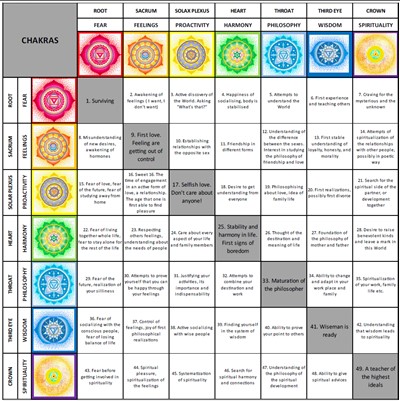
The 7×7 matrix of Vedic Chakras ends at 49 years, a reflection of a time when life expectancy was around 50-60 years. But with people now living much longer, we have more time to achieve what was once compressed into a 49-year span. For example, the 3rd Chakra (15-21 years) traditionally involves seeking stable relationships, but today’s Emerging Adults (19-24 years) or even those in their late 20s are often not ready for such commitments. The 7th Chakra (43-49 years) represents spiritual maturity, but in modern life, this stage of soul-searching is often postponed to later years.
Time for a Change
I believe it’s time to redefine these age-old models and adapt them to today’s lifestyles. The 6-year Blobs capture the shifts and patterns in a way that feels more natural and aligned with how we live now. What do you think? I’d love to hear your views!
Read more about the 6 year Blobs:
Spring: 1-6, 7-12, 13-18, 19-24
Summer: 25-30, 31-36, 37-42, 43-48
Autumn: 49-54, 55-60, 61-66, 67-72
Winter: 73-78, 79-84, 85-91, 91-…
References and Resources
Does the Human Body Really Replace Itself Every 7 Years?
Study Finds a 7-Year Itch, and a 4-Year One
Forget the seven-year itch, the real test comes at TWELVE years
The Greek Concept of the “Seven Stages of Life”and Its New Testament Significance
The Stages of Life According to Rudolf Steiner

 Life Stages in Six-Year Blobs – Personal Growth by Age
It may just be me, but it seems like my life has happened in 5 year cycles. I wonder if we don’t all have different cycles, depending on our life circumstances and personality?
LikeLike
That’s really interesting. I don’t think you are alone, because I also have a friend who keeps track of his life in a life-calendar divided up in 5 years. He writes all major milestones of that 5-year period in each box. He is now 50 and enjoys looking at his calendar every now and then. Everyone is different and I can imagine major milestones happening at 5 year intervals too e.g. start schooling at 5, puberty breaks in at 10, finish basic schooling at 15, finish vocational studies and start working at 20, maybe first kid at 25,….This example of course being a little fast-forwarded :). Would be interesting to hear your version!
LikeLiked by 1 person
Hmm… I think it’s not so much the life events I did predict, but the life events I couldn’t predict; i.e. moving, job changes, illnesses/deaths, relationship changes, etc. Those for me overpowered the typical changes. Of course it’s not exact; I would characterize 14-20 as one cycle, for instance.
LikeLiked by 1 person
Great article, which challenges and corrects old held belief systems. Well written and interesting and relevant info!
Thanks!
LikeLike
Thank so for liking, Shaleza. Glad you liked it! Any thoughts about the 6 year blobs?
LikeLike
This was really interesting!
LikeLike
Interesting post. I know in the Bible the number 7 represents completeness. It is used 735 times in Scripture! I wonder if there’s a connection. Today I published the next chapter of my cancer journey after a break.
LikeLiked by 1 person
1,3,8 and 9 are also such special numbers. The only connection I heard 6 with is with the passage of time (12 months in a year, 12 hours in a day,….)
LikeLiked by 1 person