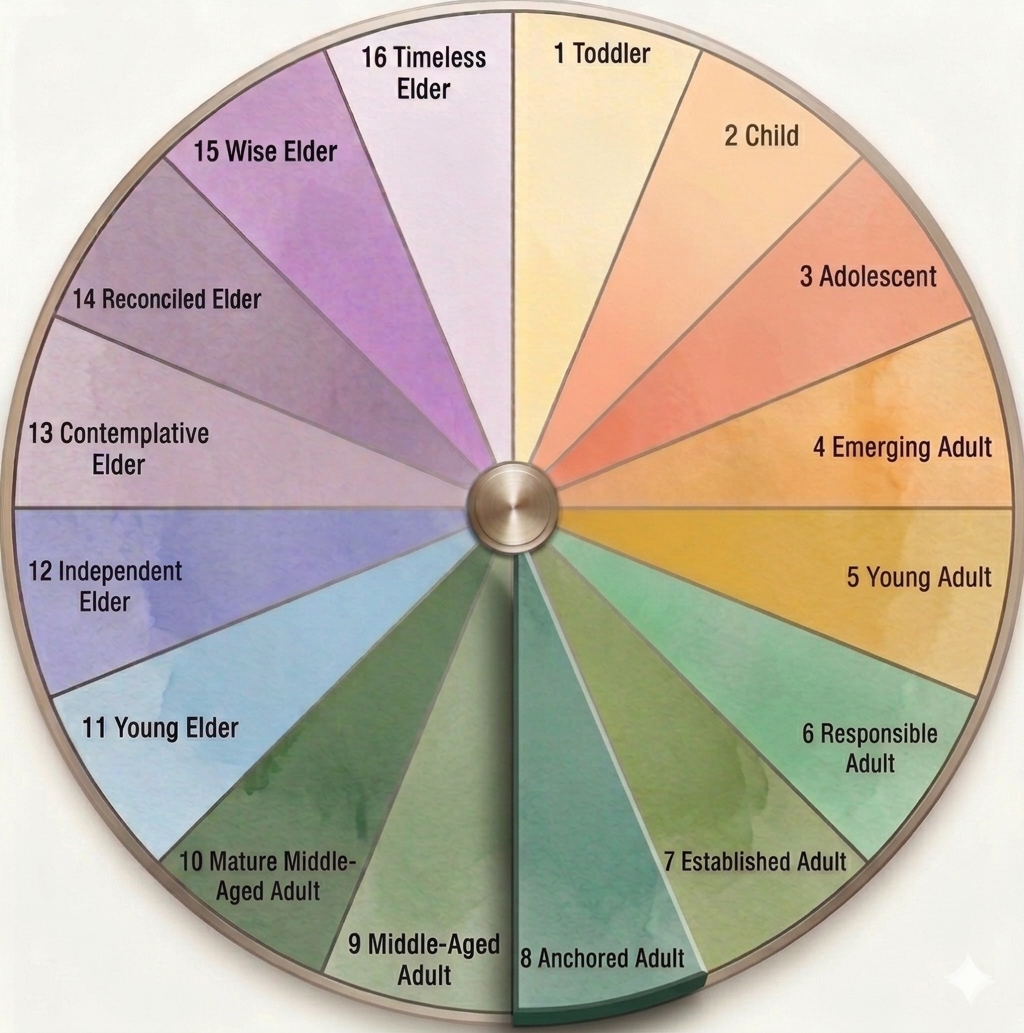
Generativity at Its Peak
Erik Erikson identified generativity as the central task of middle adulthood: the concern with establishing and guiding the next generation, and with contributing something lasting to the world. In the Anchored Adult blob, this task reaches its fullest expression. The reassessment of the Established Adult years has done its work. Values have been clarified. Priorities have been reordered. What remains is the question of how to use the time, capability, and influence that have been accumulated, and to what end.
Generativity is one of Erikson's most misunderstood concepts, because it is so often reduced to parenthood. But Erikson was clear: generativity is about anything you create that outlasts you. Children, yes. But also the people you mentor, the knowledge you transmit, the work you put into the world with the intention that it will keep mattering after you are gone. The mid-forties are, for many people, the first time this idea stops being abstract and becomes urgent.
The Career at Peak Power
The Anchored Adult blob typically represents the years of peak professional productivity. Two different kinds of intelligence operate in human cognition, and they follow different developmental trajectories. Fluid intelligence, the ability to think quickly, process novel information, and hold multiple things in working memory simultaneously, begins a gradual decline in the mid-twenties. Crystallised intelligence, the accumulated knowledge, expertise, pattern recognition, and contextual judgement built through experience, continues to grow well into middle age and beyond.
In the mid-forties, crystallised intelligence is at or near its peak. This is the person in the room who has seen this situation before, who can read the dynamics of a complex system, who knows what the textbook doesn't say. The combination of senior responsibility, deep expertise, and the clarity that comes from having already done the midlife reassessment makes many people in this blob exceptionally effective professionally, and often more satisfied with their work than they were a decade earlier.
Crystallised Intelligence: Why This Phase Is Cognitively Powerful
Crystallised intelligence is the form of cognition built from everything you have read, learned, practised, and experienced. Unlike fluid intelligence, which peaks in young adulthood and gradually declines, crystallised intelligence grows with age, often continuing to strengthen into the sixties. It is the reason a 45-year-old expert consistently outperforms a faster-thinking 25-year-old in their domain: not despite their age, but because of it. The mid-forties are not the beginning of cognitive decline. They are the peak of a different and arguably more valuable kind of intelligence.
The Sandwich Generation at Full Intensity
The Anchored Adult blob is frequently the most intense period of what sociologists call the "sandwich generation" experience: being simultaneously responsible for children who still need active parenting and for parents who are beginning to require care. Add a demanding career and a relationship that deserves attention, and the logistics of this blob require a degree of organisational competence that would be impressive in a chief operating officer.
The emotional demands are equally significant. Watching parents age, and beginning to confront the reality of their mortality, is a developmental experience in its own right, one that often prompts the deepest engagement yet with questions of legacy, meaning, and what it means to live a life well.
The Body Changes Its Contract
The physical changes of the Anchored Adult blob are real, visible, and culturally loaded in ways that are not evenly distributed. Presbyopia, the gradual loss of near-focus ability, typically arrives in the mid-forties, and reading glasses become a practical necessity for most people. Grey hair and wrinkles are now established rather than emerging. Middle-age spread, the redistribution of body fat toward the abdomen, is common in both sexes, driven partly by hormonal changes and partly by reduced activity levels. Immune function begins a slow decline. Recovery times lengthen.
The gender disparity in how these changes are received socially is pronounced and well-documented. Men's perceived social desirability, particularly in professional and romantic contexts, frequently peaks in middle age: grey hair reads as distinguished, experience as authority, age as gravitas. Women face a sharply different cultural calculus, in which visible ageing is routinely interpreted as a loss of value, and the pressure to maintain a youthful appearance intensifies precisely as the body makes that appearance less available. This asymmetry is neither inevitable nor permanent. It is the current reality, and naming it clearly is the beginning of navigating it on your own terms.
The Second Half Begins Here
The late forties mark the threshold of Autumn, and the Anchored Adult blob is where the intentions for that second half are formed. Long-deferred projects get started: the book that was always going to be written, the creative practice that was set aside during the building years. These are not mid-life panics. They are the expression of generativity in its purest form: the redirecting of accumulated capability toward something that matters.
The central insight of this blob is that generativity is a choice. Stagnation, Erikson's opposing pole, is not simply inactivity. It is the condition of someone who has turned inward, who has stopped contributing to anything larger than themselves, who has allowed the accumulated weight of obligation to extinguish the impulse toward meaning. The Anchored Adult who chooses generativity, in whatever form that takes, is not simply having a good midlife. They are laying the foundation for everything that Autumn can be.