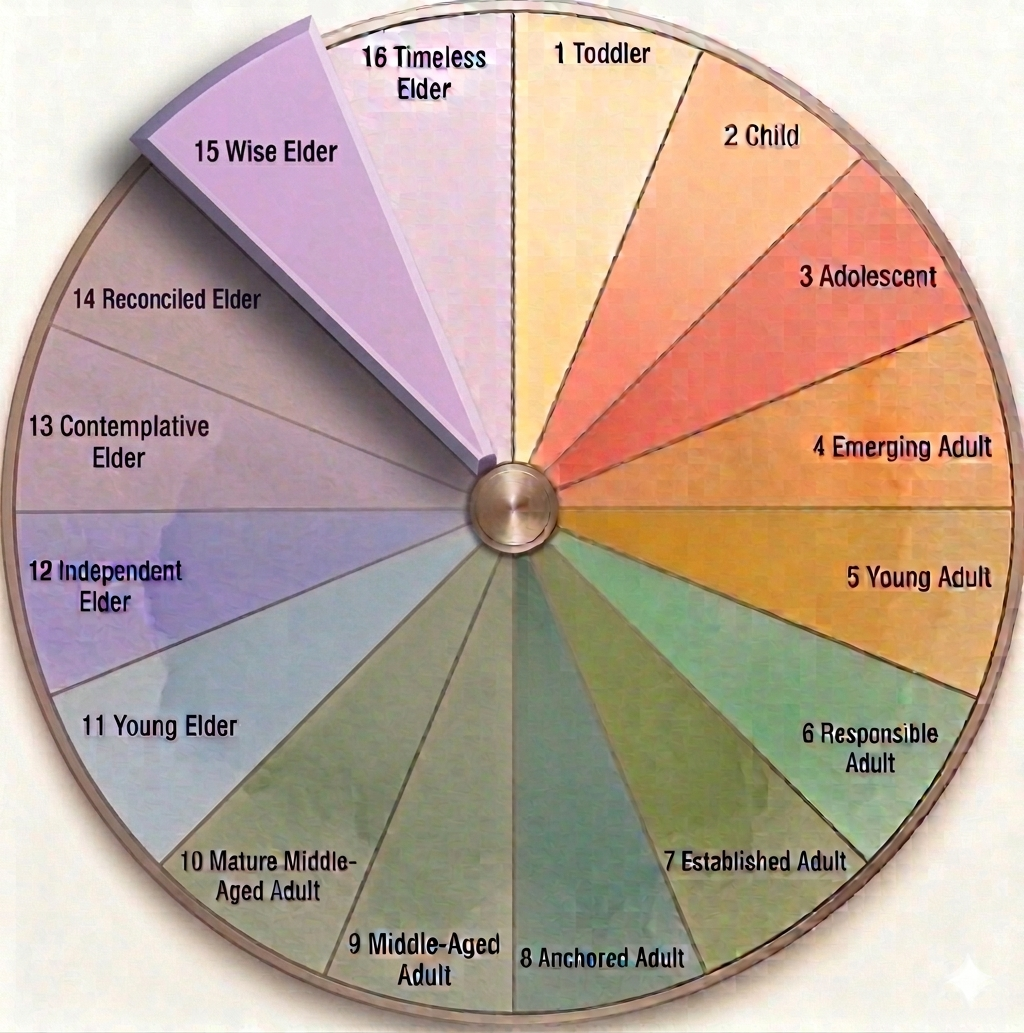
Strength Through Experience
To reach 85 is to have survived what most have not. It is to have outlasted spouses, friends, and sometimes children. It is to have adapted through technological revolutions and private tragedies that would have stopped others cold. The Wise Elder Blob is defined not by fragility, though fragility is real, but by a quality of resilience that has been forged through decades of consequence. These are people who know how to keep going, because they have done it so many times before.
Erikson placed the resolution of integrity in this stage. The sense that one's life has been one's own, that its contradictions and losses and joys form a coherent whole worth having lived. When that resolution is reached, what remains is something that genuinely deserves the name wisdom: perspective earned through decades of consequence.
A Growing Demographic
Those aged 80 and over currently represent just over 1% of the global population. That figure sounds small until you consider what it represents in sheer human number, and what it is projected to become. By 2050, this proportion is expected to reach 4.1%, making the oldest-old the fastest-growing demographic segment on the planet. Societies that have not yet reckoned with this reality will need to do so urgently.
Within Europe, Eurostat data tells a striking story about how people in this Blob actually live. Approximately 50% of women aged 85 and over live alone, as do around 28% of men. Only about 13% are in care facilities. The rest are in private households, managing with family support or informal networks. These people are everywhere, largely invisible, and frequently underserved.
Choosing Home
Despite the considerable challenges of this stage, many people in their late eighties actively and deliberately choose to remain at home. Not from lack of alternatives, but from a clear sense of where life is most liveable. Telecare technologies and adapted housing increasingly make this viable. The question for societies is whether they are investing sufficiently in these options, or defaulting to institutional care because it is more visible and easier to commission.
For those living alone, the risks are real. Social isolation, delayed help-seeking, falls with no one present. But the evidence is equally clear that autonomy itself has a protective function. People who feel in control of their lives, even in constrained ways, show better health outcomes than those who feel managed by others. Autonomy is not a luxury at this stage. It is a health intervention.
The Gem Metaphor
One of the most resonant ways to understand people in their late eighties is through the image of a gem: mined with difficulty from deep in the earth, cut and shaped through pressure and time, buffed until something extraordinary is revealed. What 85 years of living produces is not simply an old person. It is someone whose accumulated worth, in story, in perspective, in love given and received, is genuinely rare.
Approximately 30% of people aged 85 to 89 are living with some form of dementia. This is a serious reality and should not be minimised. It also means that around 70% are not, and that within those affected, enormous individual variation exists in capacity and quality of life. The real danger of this stage is invisibility: the way society's neglect of people over 85 constitutes both a moral failure and a wasted resource of extraordinary magnitude.
Meaningful connection at 85 looks different from meaningful connection at 35. It may be quieter, more intermittent, more dependent on others' initiative. But its importance has not diminished. What people at this stage most want is not sympathy. It is genuine engagement. To be heard, not merely cared for. To matter.
The Fastest-Growing Demographic
Those aged 80 and over are just over 1% of the world's population today, projected to reach 4.1% by 2050. This is the fastest-growing segment of the global population, with profound implications for healthcare systems, urban design, and social policy. Meanwhile, 50% of women and 28% of men aged 85 and over in Europe live alone. How societies support this group, in practical terms and in meaningful ones, is one of the defining challenges of the coming decades.