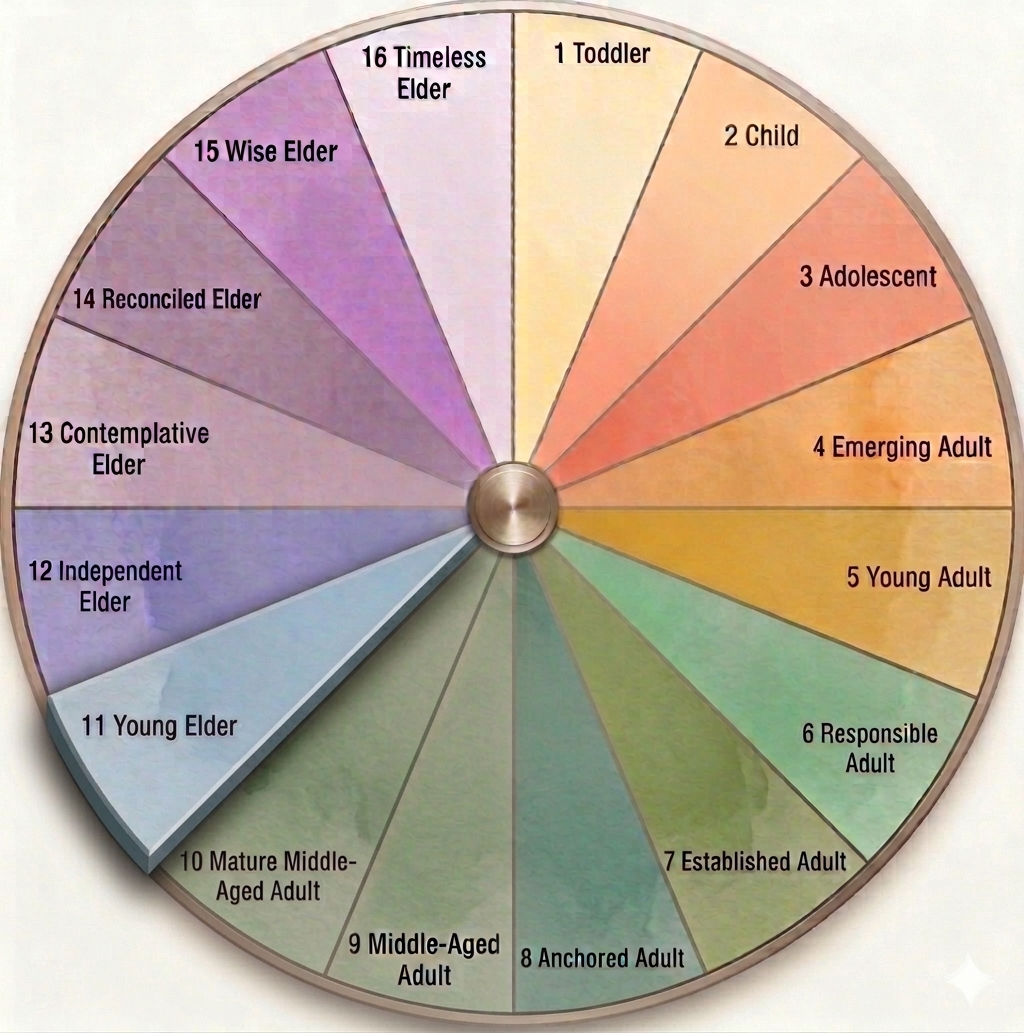
Not Yet Past It
Demographers and marketers have struggled to name this group adequately. "Senior" feels premature. "Middle-aged" is technically inaccurate. The labels that have stuck, "Geriactives," "Nyppies" (Not Yet Past It), reveal more about the inadequacy of our existing categories than about the people themselves. What they share is a fundamental shift: they are stepping away from, or actively renegotiating, the work structures that organised adult life for three to four decades, and entering a new era that has no well-worn cultural script.
This is a genuinely novel historical situation. The 61–66 blob represents a large, healthy, experienced, economically significant population for which no previous generation has provided a clear template. The opportunity, and the challenge, is that the script has to be written fresh.
The Bismarck Problem
Retirement at 65 is not a biological fact. It is a political invention. Otto von Bismarck introduced the world's first state pension in 1889, setting the age of eligibility at 70, later reduced to 65, at a time when average life expectancy in Germany was approximately 45 years. The policy was designed for a world in which almost no one would actually collect it. That world no longer exists.
Today, 90% of 65-year-olds report being in good health. Of the next 20 years of life after 65, roughly half are expected to be free of significant disability. The body and mind at 61–66 are, for the majority of people, substantially more capable than the institutional architecture of retirement was ever designed to accommodate.
The Bismarck Problem
Retirement at 65 was designed in 1889 for a world where average life expectancy was 45. Today, 90% of 65-year-olds are in good health, and half of the two decades following 65 are expected to be disability-free. The question for this generation is not whether to retire. It is whether a concept invented for a different world still makes sense at all, and what to put in its place.
Generativity: Passing It Forward
Erikson's concept of generativity, the drive to contribute to something that will outlast you, reaches one of its most active expressions in this blob. With decades of accumulated expertise, and often for the first time with genuine time and freedom, people in their early 60s are well-positioned to become genuine contributors to the next generation: as mentors, trustees, or simply as elders in the original sense, people who carry and transmit hard-won knowledge.
The mentoring relationship, in particular, offers something distinctive at this stage: the mentor gains meaning, relevance, and cognitive engagement. The mentee gains access to expertise that cannot be found in any training programme. This is one of the clearest win-win propositions in adult development.
Rethinking What Comes Next
Alternative approaches to this life stage are proliferating. Some people continue modified work, reducing hours, shifting from management to advisory roles, moving from employed to self-employed. Others pursue entirely new skills: this is the decade of the mature student, the late-blooming painter, the first-time language learner. Others focus outward, on community, caregiving, advocacy, and service.
What the research consistently shows is that the specific activity matters less than whether it carries genuine purpose, the sense that what you are doing matters to someone beyond yourself. People who maintain that quality of engagement in their 60s show substantially better cognitive and physical health trajectories into their 70s and beyond.
Economic Weight
The economic scale of this group deserves attention. By 2030, 59% of consumption growth globally is projected to come from people over 60. The 61–66 blob alone represents a market, and a civic constituency, of enormous consequence. In most developed economies, this group is among the most financially secure and politically engaged demographics. Their choices about how to spend time and money will shape societies in ways that are still being underestimated.
The Body at 61–66
The physical profile of this stage is characterised by gradual and manageable change for most people. Skin loses elasticity. Taste and smell become somewhat less acute. Hearing loss, which typically begins in the 40s, becomes more noticeable, with approximately one in three people in this age group experiencing significant hearing impairment, though many go undiagnosed. Caloric needs drop by roughly 20% compared to midlife, requiring adjustment to long-established eating habits.
Cognitively, learning genuinely new information becomes harder. But existing areas of expertise become, if anything, richer and more integrated. The experienced teacher, doctor, engineer, or parent does not know less at 63 than they did at 43. They know differently, and often more usefully. The library is larger, and the filing system is better.
What Do I Want to Give?
The retirement question, at its best, is not "should I stop or keep going?" It is a richer and more generative question: what do I actually want to contribute, to whom, and on what terms? That reframe, from withdrawal to purposeful engagement, is the developmental task of the Young Elder blob. Not every answer looks like paid work. But most good answers involve staying in motion, staying connected, and staying useful.