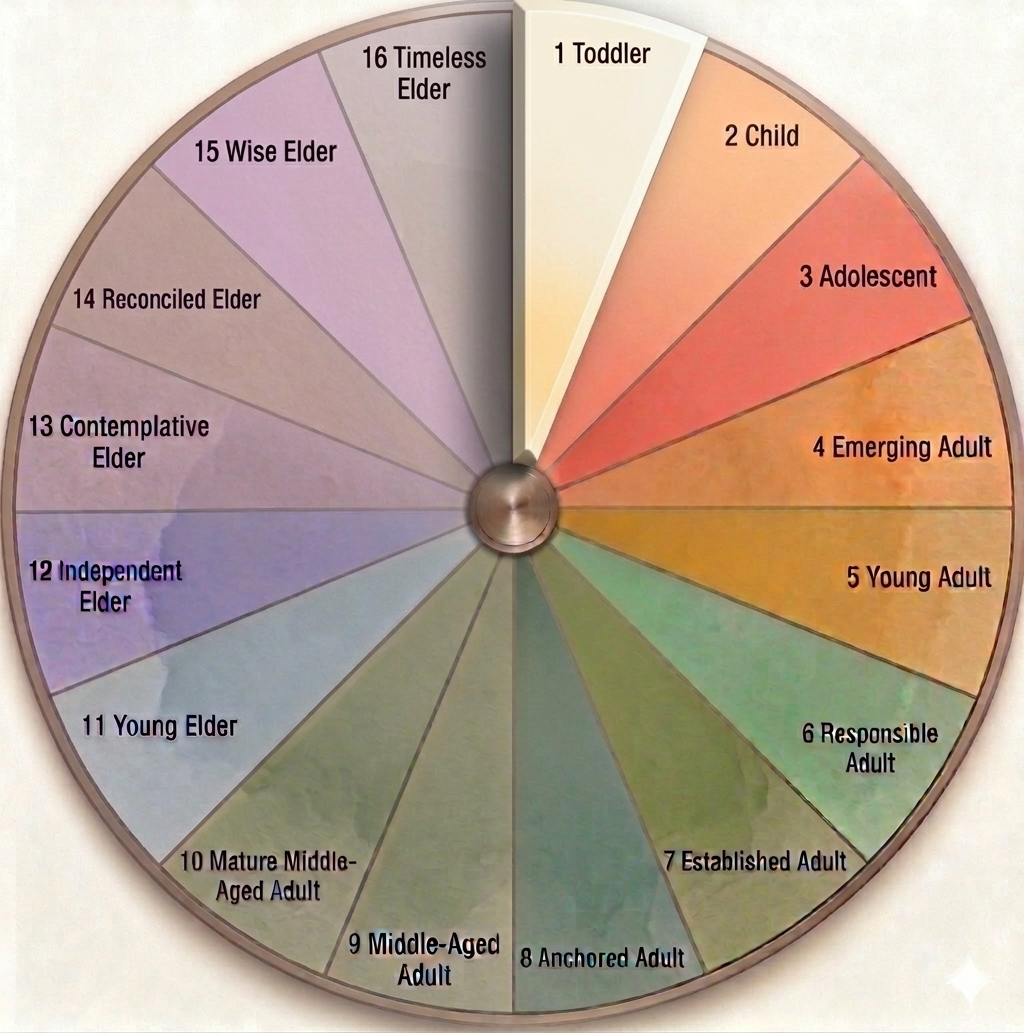
The first six years contain more change than any other Blob in the framework. No other stage sees a human being go from complete helplessness to running, talking, reasoning, and forming friendships. This Blob contains three mini-stages that mark the journey: Newborn, Baby, and Infant. Each is distinct enough to name, but together they form one continuous arc that ends with a recognisable, opinionated, imaginative small person.
Mini-Blob
Newborn · 0–6 weeks
The newborn arrives with a set of reflexes that are both ancient and precise. The rooting reflex turns the head toward any touch on the cheek, orienting the baby toward food. The grasp reflex closes the fingers around anything placed in the palm with surprising strength. The Moro reflex, triggered by a sense of falling, throws the arms wide and then draws them back in, a survival response older than our species.
These reflexes are not decoration. They are the operating system of a being adapting to a world it has never experienced before. In the first six weeks, the central tasks are physiological: breathing air, regulating temperature, adjusting to feeding rhythms, managing the digestive system. Sleep is fragmented and frequent. The brain is processing an overwhelming quantity of new sensory information.
What matters most in these weeks is not stimulation. It is security. The consistent presence of a calm caregiver, the reliable satisfaction of hunger, the experience of being held and soothed: these are the raw materials from which trust is built. Erikson called this the stage of Trust vs. Mistrust, and the stakes are exactly that high.
Mini-Blob
Baby · 1–6 months
Somewhere around 6 weeks, something shifts. The first social smile appears: deliberate, targeted at a face, entirely unmistakable. This is not a reflex. It is communication. The baby has discovered that their expressions produce responses in the people around them, and they begin to use this knowledge.
The 1–6 month period is a rapid physical awakening. Neck muscles strengthen. The baby learns to hold up their head, then to roll. Vision sharpens: at birth, focus is possible only at about 30 cm; by 3 months, the baby tracks moving objects with clear intentionality. The world is coming into focus, literally.
Cognitively, the concept of cause and effect is forming. A kick makes the mobile move. A sound brings a face. The baby is running experiments, building a model of how the world responds to their actions. Sleep begins to consolidate, stretching into longer stretches. Feeding rhythms become more predictable. The caregiver and the baby settle into each other.
Mini-Blob
Infant · 6–12 months
The infant gets mobile, and everything changes. Crawling arrives somewhere between 6 and 10 months, followed by pulling up to stand, cruising along furniture, and for many babies, first steps before the first birthday. The pincer grasp develops: the ability to pick up small objects between thumb and forefinger, which opens an entirely new relationship with the physical world.
Stranger anxiety appears in this period, typically between 7 and 10 months. A baby who previously beamed at anyone now protests being held by unfamiliar faces. This is not regression. It is cognitive progress: the baby has formed a clear mental model of their primary caregivers and can now distinguish them from everyone else. Stranger anxiety is a sign of secure attachment, not its absence.
Language comprehension precedes production. The infant understands simple words, their own name, and common instructions well before they can say anything. The first words typically arrive between 10 and 14 months. Before that, babbling becomes increasingly sophisticated, mimicking the rhythm and intonation of adult speech. The baby is rehearsing.
The Toddler Years: 1–6
With mobility and language beginning, the real toddler phase takes hold. By the end of the fifth year, the brain has reached approximately 90% of its adult weight, having tripled in mass since birth. New neural connections are formed and pruned at a rate that will never be matched again. Every conversation, every story, every scrape is literally shaping the architecture of the brain that will carry this person through the rest of their life.
The Autonomy Drive: "No!" as a Milestone
Around 18 months to 2 years, most toddlers discover the power of refusal. The word "No!" signals a profound developmental achievement: the child has discovered themselves as a separate person with their own will. This is Erikson's stage of Autonomy vs. Shame and Doubt. The task of caregivers is to hold firm boundaries with warmth rather than punishment, so the child learns self-determination without shame.
Tantrums Are Communication, Not Manipulation
The toddler tantrum is best understood not as bad behaviour but as the expression of a nervous system that is genuinely overwhelmed. Toddlers feel emotions with adult intensity but have almost none of the regulatory capacity to manage them. The prefrontal cortex, responsible for emotional regulation, is years from maturity. When a toddler melts down because their banana broke or their socks feel "wrong," they are experiencing a genuine neurological storm, not performing for effect. Calm, consistent presence: naming the emotion, providing physical comfort if wanted, and waiting for the storm to pass. Emotional security, built through hundreds of these micro-moments, is the foundation of resilience.
Language: The Vocabulary Explosion
At 12 months, a child typically has a handful of words. By 24 months, most children have 200–300 words and are combining them into simple sentences. By age 5, the average child has a productive vocabulary of around 2,000 words and can use complex sentences and tell stories. The endless "why?" questions of the 3–5 year period are the engine of conceptual understanding. The toddler is building a model of how the world works, one question at a time.
Imaginative Play: The Laboratory of the Mind
Between 18 months and 2 years, symbolic play emerges: a block becomes a car, a cardboard box becomes a rocket. By 3–4 years, imaginative play has become elaborate and sustained. Children construct complex narratives, assign roles, and inhabit characters for extended periods. This is not idle entertainment. Children who have rich opportunities for free, unstructured play show stronger executive function and greater social competence. The toddler years are the most creative period of human life. Creativity does not need to be taught at this age. It flourishes when given safety, time, and freedom.
Right-Brain Dominance: The Emotional Foundation
Neurologically, the first years of life are a period of right-brain dominance. Emotional experience, the felt sense of safety, love, and fear, is processed with unusual intensity during these years. Emotional security is not optional in the toddler years. It is the ground on which all other learning stands. A child who feels emotionally safe can explore, take risks, and tolerate frustration. A child who is chronically anxious uses cognitive resources for survival rather than growth.