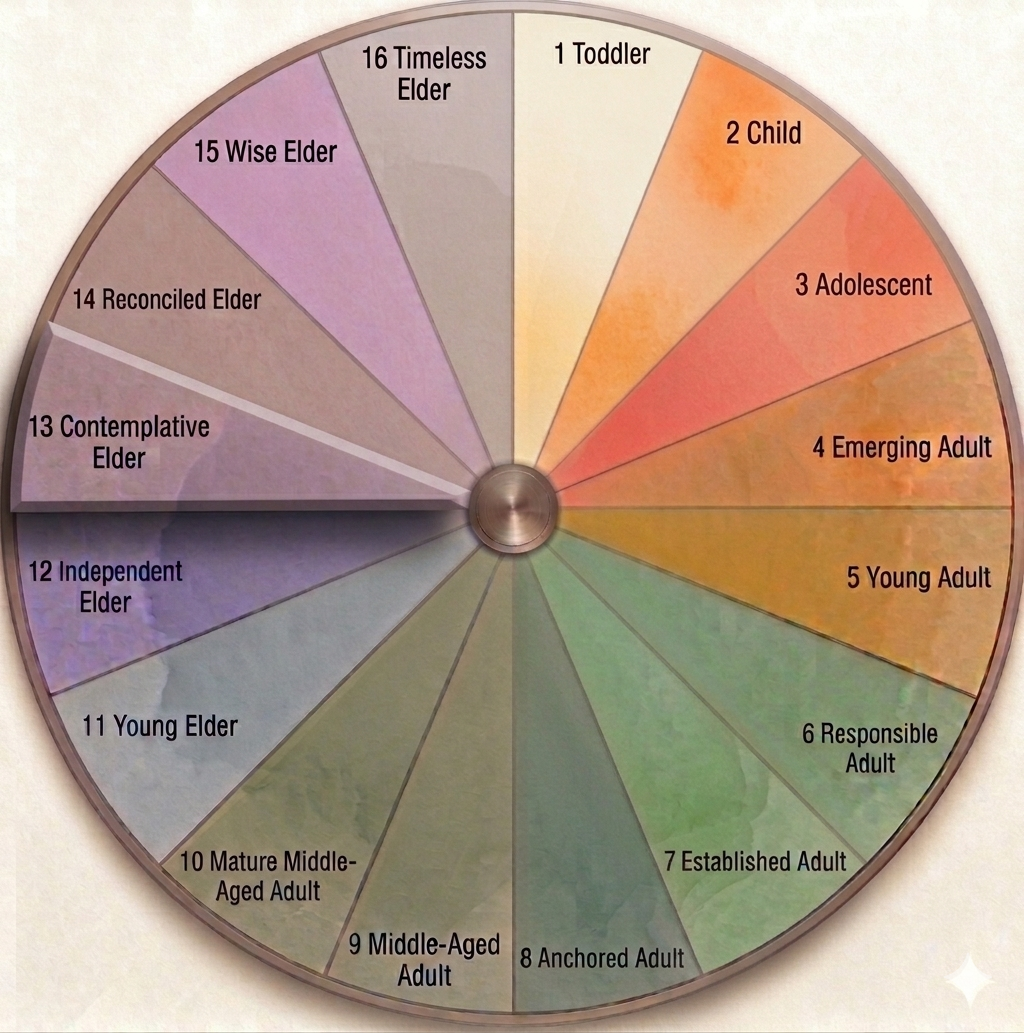
A Profound Shift
The Contemplative Elder years mark a profound shift in how people relate to their own bodies, time, and sense of self. Physical limitations that were once abstract possibilities now arrive as concrete daily companions. A stiff hip, a shortened walk, the gradual handing over of car keys. For many, though, these years are defined by a quality of reflection and inner richness that earlier decades rarely afforded.
The core developmental task at this stage, as Erik Erikson described it, is resolving the tension between integrity and despair. Finding a sense that one's life, taken as a whole, has had meaning and worth. This is not a passive reckoning. It is an active process of storytelling, re-evaluation, and often, surprising acceptance.
Cultural Context: Honoured or Overlooked?
Not all cultures treat this life stage the same way. In many Eastern and African traditions, elders of 73 and beyond are recognised as wisdom-keepers. Their accumulated experience is a community resource, not a social inconvenience. Age brings status, and the elder's counsel is sought. Many Western contexts, particularly those organised around productivity and youth, risk leaving people in this age group feeling irrelevant, as though their worth expired at retirement.
This cultural backdrop matters enormously. Elders who feel valued by their communities consistently report higher wellbeing. Those who sense they have become invisible often struggle more with the psychological dimensions of ageing, regardless of their physical health. The world a person inhabits shapes them as much as the biology within them.
Physical Realities
Between 73 and 78, most people encounter a cluster of physical changes that require genuine adaptation. Mobility tends to decline, with arthritis and rheumatism among the most commonly reported difficulties. Driving, that emblem of independence in many Western cultures, often becomes more limited or is given up entirely. Vision changes, including cataracts, may require surgery. Cardiovascular function demands increasing attention.
The most common health concerns during this Blob include arthritis, cataracts, dental issues, diabetes, hearing loss, heart disease, and hypertension. None of these are inevitable, and many are manageable. One particularly striking example: hearing aids, when adopted, can improve an older adult's communicative capacity by around 50%. That is a substantial quality-of-life gain that many people delay seeking, often due to stigma.
The Paradox of Subjective Health
One of the most fascinating and counterintuitive findings from gerontological research is this: despite objective physical decline, most people in their mid-to-late seventies report a stable or even positive perception of their own health. This is sometimes called the wellbeing paradox. Older adults frequently rate their life satisfaction higher than people in middle age, even when facing objectively greater physical challenges.
Part of the explanation lies in how elders make comparisons. Unlike younger people who may measure themselves against idealised standards, older adults tend to compare themselves with their age peers. "For 76, I'm doing quite well" is a psychologically protective and genuinely meaningful frame. It is not denial. It is adaptive cognition.
What Helps: Coping at 73–78
Research consistently points to personal control as a pillar of wellbeing at this stage. The ability to make decisions about one's own day, body, and environment turns out to be protective in ways that medication rarely matches. Social connection matters too, though the Blobs framework is clear that quality outweighs quantity.
Reflection itself, contemplation about one's life and its meaning, is not merely passive. It is a form of psychological work. People who engage in life review during this Blob often arrive at a quality of peace that is genuinely hard-won and deeply felt. The inner life, tended carefully, becomes a refuge.
The Wellbeing Paradox
Why do older adults so often report higher life satisfaction than middle-aged people, even when facing greater physical challenges? Research points to a shift in how we make comparisons and what we no longer feel compelled to compete for. By their seventies, many people have let go of the anxious striving that burdens earlier decades. What remains is something quieter and more durable: a hard-earned perspective that younger people can barely imagine.