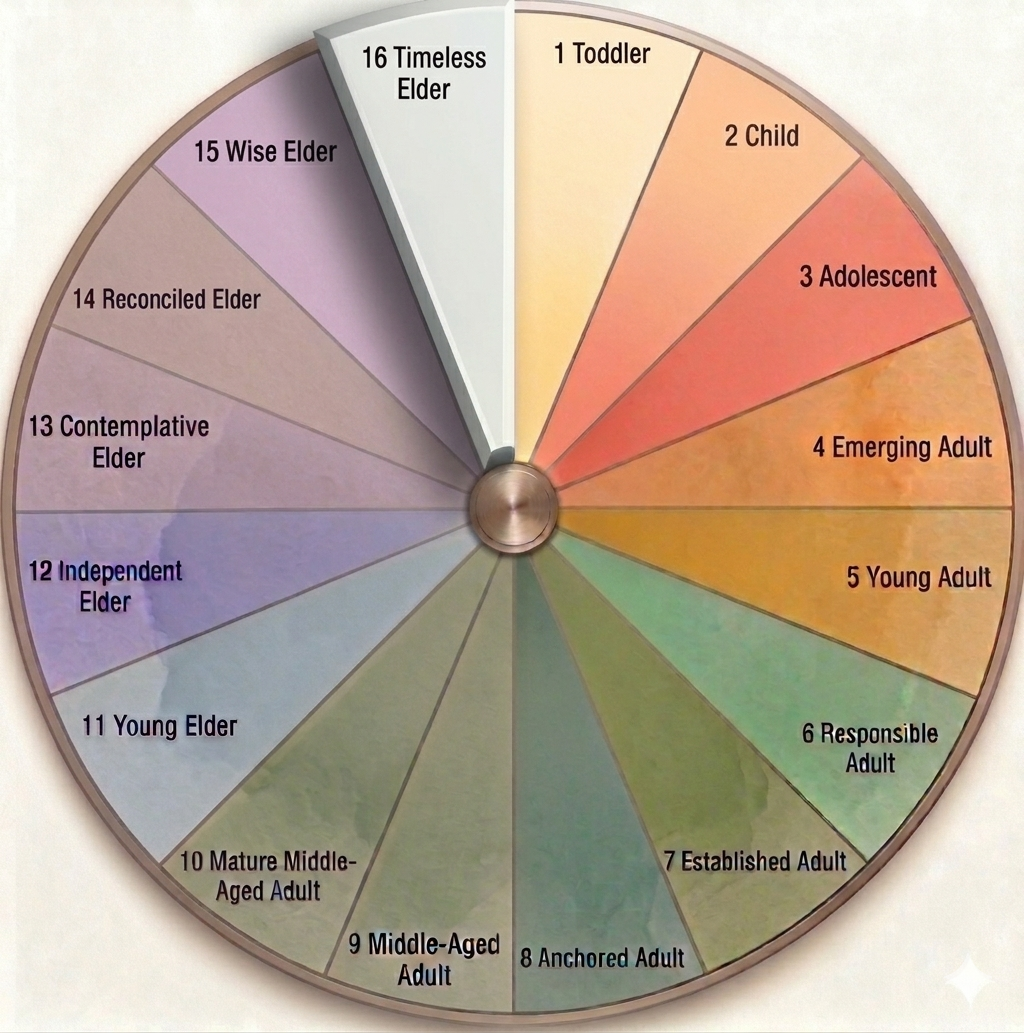
A Century of Living
In 1917, Britain had 24 centenarians. Today, it has more than 15,000. This is one of the most remarkable quiet transformations in human history. People are living past 100 in numbers that were once unimaginable, and the trend is accelerating. Globally, the centenarian population is projected to increase tenfold between 2010 and 2050. Approximately 80% of those who reach 100 are women.
The Timeless Elder stands outside conventional developmental frameworks. Erikson's final stage, integrity versus despair, has for many at this age been resolved long ago. What lies beyond is something closer to transcendence: a relationship with time, self, and mortality that is qualitatively different from anything earlier decades can produce. These are not simply old people. They are witnesses to an expanse of human experience that most of us will never access.
What Centenarians Have in Common
Research into people who reach 100 and beyond reveals a cluster of characteristics that appear with striking consistency. Adaptability sits at the top. Centenarians have typically faced devastating losses and disappointments, and have mourned them fully before moving forward. They do not suppress grief. They metabolise it. Alongside this sits an unusually strong memory, particularly for meaningful events and relationships. A keen interest in current events is another common thread. These are not people who have retreated from the world. They are often more curious about it than people half their age.
Lifestyle patterns also show consistency. Many centenarians sleep 6–7 hours, often as early risers, drink coffee regularly, and take minimal medication. Their bodies, having survived this long, have established their own equilibrium.
The Longevity Formula
Seven factors appear most consistently in research on people who live past 100: positive and realistic attitudes, balanced and nutrient-rich nutrition, regular physical and mental activity, strong faith or spiritual practice, ethical living and a clear sense of personal values, supportive and meaningful relationships, and good genetics. No single factor dominates. These are people who have been, in some sense, good at living for a very long time.
Eileen Ash, a British woman who served as a Second World War intelligence officer and played international cricket for England, was practising yoga in her garden at the age of 102. Across cultures and countries, centenarians who maintain physical practice tend to do so with a matter-of-fact consistency rather than extraordinary discipline. It is simply what they do.
Attachment, Loss, and Serenity
Perhaps the deepest lesson that centenarians offer is about the relationship between loss and serenity. By 91, most have outlived their generation. Spouses, siblings, and often children. The grief involved in this kind of accumulated loss is not a single event but an ongoing condition. And yet, in interview after interview, people at this stage describe a quality of peace that coexists with that grief.
This is the paradox of extreme old age: great loss and great serenity can occupy the same life simultaneously, not cancelling each other out but somehow deepening both. Attachment does not diminish with age. If anything, the connections that remain become more vivid precisely because so many others have been released. What centenarians teach us about love and resilience cannot be found in books. It can only be found by listening to them.
The Centenarian Formula
Research on people who reach 100 consistently identifies seven traits: positive and realistic attitudes, balanced nutrition, regular physical and mental activity, strong faith or spiritual grounding, ethical living, supportive relationships, and good genetics. What is striking is not any single factor but the pattern. A life lived, over a very long time, with intention, adaptability, and connection. These are not traits reserved for the extraordinary. They are available to anyone willing to practise them, starting now.