The First Blob of Autumn
I turned 55 last year, which means I have just walked through this Blob. And I can tell you: nobody warned me that the years between 49 and 54 would feel so contradictory. I felt more capable than I had at 35, more sure of what mattered. But I also felt time pressing against me in a way it never had before. For the first time, the years behind me outnumbered the years ahead. That is not a small thing.
If you are in this Blob now, you probably recognise that odd sensation. Not a crisis, exactly, but a reckoning. You have spent decades building a life. Now something inside you is asking: is this the life I actually want?
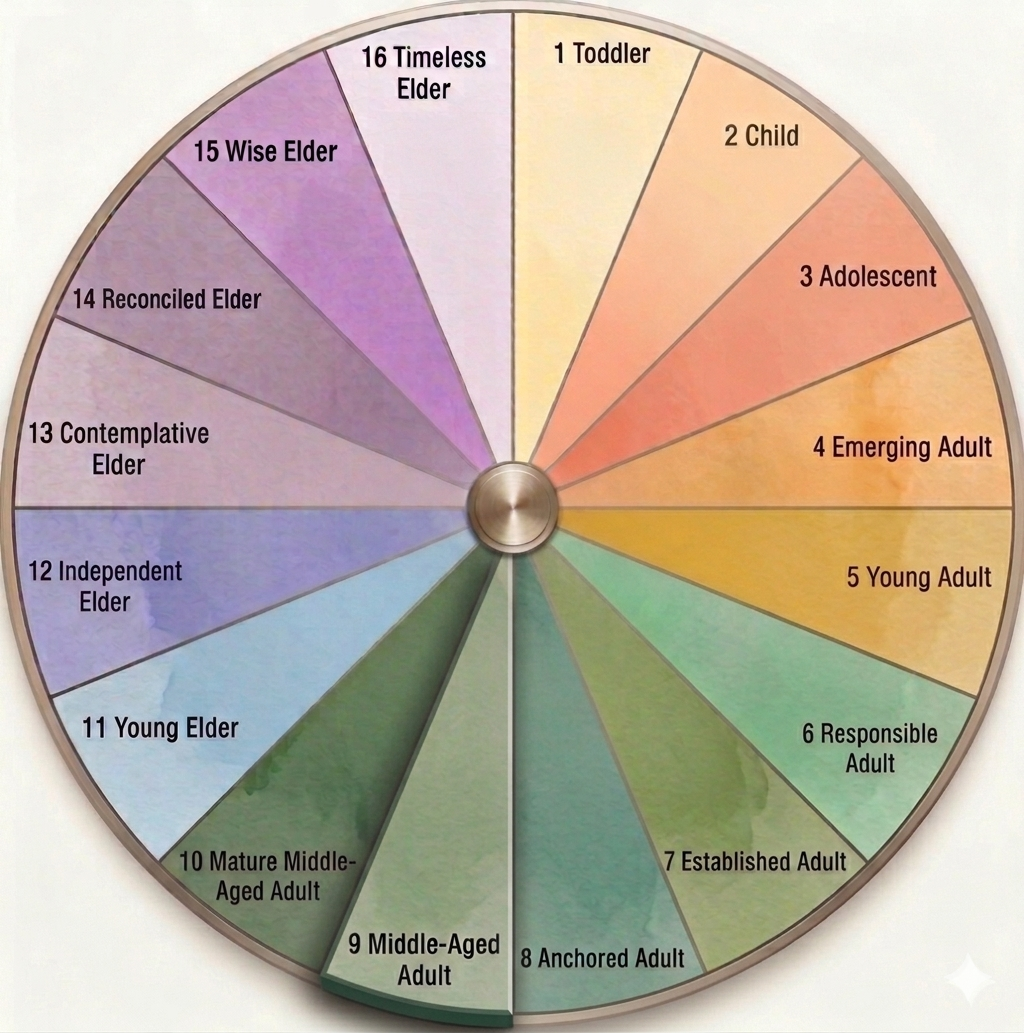
In the Blobs framework, this stage marks the opening of Autumn. Spring was for absorbing and growing. Summer was for executing and building. Autumn is for harvesting, yes, but also for questioning what you planted and whether you still want to tend it.
What the science actually says about your brain right now
You may have heard that everything goes downhill after 50. The research says the opposite is more interesting than that.
The Seattle Longitudinal Study tracked 6,000 adults across decades of cognitive testing. It found that different mental abilities peak at very different ages. Some reach their high point in the early 20s. Others do not peak until the 40s or later. There is no single moment when the brain begins its decline.
White matter, the tissue that forms connections between neurons, keeps growing until around age 50. Your brain is still building new infrastructure at 49.
What does slow down is processing speed. Your reaction times are not what they were at 25. You might forget a name mid-sentence or walk into a room and forget why. These small lapses are real. But they sit alongside something significant: your capacity for pattern recognition, moral reasoning, and emotional judgment is at or near its peak. Research from the University of Southern California found that adults in midlife focus more on positive information and remember it better. The midlife brain is calmer, less reactive, and better at reading social situations.
"Financial decision-making ability peaks around age 53. Not at 30, when you had faster reflexes. At 53, when you had experience."
The midlife dip is real. But it is not what you think.
A study across 145 countries confirmed that life satisfaction reaches its lowest point somewhere near age 48 to 50. Researchers call this the U-curve of happiness. Wellbeing drops through the 30s and 40s, bottoms out near 50, and then climbs again.
But here is what gets lost in the headlines: only 10 to 20 percent of adults report experiencing anything that could be called a midlife crisis. For the rest, midlife is not a dramatic rupture. It is a quiet recalibration. Swiss psychologist Pasqualina Perrig-Chiello puts it bluntly: life stocktaking between 45 and 50 is unavoidable, because you realise the remaining years are now fewer than the years you have already lived.
That forced arithmetic can feel heavy. But it is also the beginning of a new kind of freedom. Perrig-Chiello describes an "inner freedom" that arrives after the first half of life, spent making compromises for career, family, and social expectations. In your 50s, you can finally stand by your own needs without apology.
"In your 50s, you can finally stand by your own needs without apology."
Pasqualina Perrig-Chiello, Swiss developmental psychologistGerman developmental psychologist Ursula Lehr tested the idea of a biologically inevitable midlife crisis by analysing more than 1,300 life stories. She found no evidence for it. The 20-to-30 age group was actually more crisis-prone. The popular image of the 50-year-old man buying a sports car is a cultural cliche, not a developmental fact.
How this Blob looks across cultures
The Western framing of midlife as "crisis" is one cultural story. It is not the only one.
In classical Chinese thought, Confucius described 50 as the age when he "knew the will of Heaven" (知天命, zhī tiān mìng). This was not resignation or giving up. It was the opposite: a hard-won clarity about which battles matter and which do not. Where Western psychology sees a valley to climb out of, the Confucian tradition sees a summit you have finally reached.
"Where Western psychology sees a valley to climb out of, the Confucian tradition sees a summit you have finally reached."
Confucius also added a useful corrective. He said that if a person reaches fifty and nothing has been heard of them, there is no reason to respect them simply for their age. Age alone confers nothing. It must be proved by what you do with it.
In India, the experience of this Blob centres less on existential rebellion and more on accumulated responsibility. Children's education costs, loan repayments, aging parents who need care, and property matters converge at this exact age. The pressure is less about "who am I?" and more about "how do I carry all of this?" In urban India, women in their early 50s are increasingly questioning the assumption that they exist only in the caretaker role. As one Delhi-based researcher put it, societal expectations erode with age, and with that erosion comes the confidence to live on your own terms.
In Germany, psychologists have identified something called androgynization that tends to begin in this Blob. As hormonal balances shift, men often become softer and more emotionally open, while women gain assertiveness and drive. Perrig-Chiello calls this a great opportunity: it is the reconciliation of both sides you have always carried within you.
Across cultures, one pattern is consistent. People who navigate this stage well are those who treat it as a transition to be lived through, not a problem to be solved.
Your body in this Blob
There is no pretending: primary ageing accelerates between 49 and 54. Skin loses elasticity. Joints complain more loudly. Metabolism slows by roughly a third, which means the same diet that worked at 40 will slowly add weight at 52.
For women and men both
For women, perimenopause and menopause bring a wave of changes: disrupted sleep, mood shifts, changes in energy and concentration. These are not minor inconveniences. They are a genuine physiological transition that too many workplaces and social circles still treat as something to endure silently. For men, testosterone declines gradually, affecting energy, mood, and motivation in ways that are harder to name because the culture has barely begun to talk about them.
"If you are 50 and nothing hurts, you are probably dead. It gets a laugh because it is close to the truth."
But there is another truth alongside it. People in their early 50s are running marathons, starting yoga for the first time, and discovering that they can get stronger at an age when they expected to start winding down. The body between 49 and 54 has limits. But it has more capacity than most people assume, if they choose to use it.
Relationships and the shifting ground beneath them
This Blob often reshapes relationships. Children become more independent, which can feel like freedom and grief at the same time. The parent who spent two decades organising a household around school runs and homework suddenly has open hours and no instructions for what to do with them.
The "sandwich generation" pressure is still present for many: caring for ageing parents while still supporting children. In cultures where family care is a deep obligation, like India and much of East Asia, this dual responsibility can stretch people thin to the point of breaking.
Marriages face a particular test in this Blob. Some couples rediscover each other once children need less daily attention. Others find that without the shared project of child-rearing, they have little left in common.
On marriages and divorce
In the United States, women now initiate roughly two-thirds of divorces, and many of these decisions happen in the early 50s. The reasons are rarely dramatic. More often, they involve years of feeling unseen.
For people who live alone, whether by choice or by circumstance, this Blob brings its own reckoning. You may have more freedom than your married friends, but you may also feel the absence of daily witness to your life. Both experiences deserve attention.
What this Blob asks of you
Every Blob asks something different. The 25-30 Blob asks: what will you build? The 37-42 Blob asks: can you hold it all together? This one asks a harder question: now that you have built a life, are you willing to rebuild the parts that no longer fit?
That might mean a career change. It might mean a conversation you have been postponing. It might mean admitting that you spent years pursuing something that was never really yours to begin with.
The German-Swiss psychologist Verena Kast observed that many people in midlife rediscover a longing for creativity they remember from childhood. Old interests that disappeared at 20 resurface at 50. This is not regression. It is retrieval: the return of parts of yourself that got set aside when life demanded all your attention.
"In the morning, you look outward, chasing recognition and achievement. In the afternoon, you look inward, searching for meaning and your true self."
Carl Jung, on the afternoon of lifeNot everyone makes this turn gracefully. Some people resist it and spend the next decade clinging to what no longer fits. Some embrace it and find that their 50s contain a depth their 30s could never have reached. Both paths are real. The Blobs model does not pretend this transition is easy. It simply says it is predictable, and that knowing where you stand can make the passage less disorienting.
Keep reading
If you are in this Blob right now, these posts go deeper into the questions it raises.
Five Years On: Was I Right to Ditch the 7-Year Model?
Looks back at the framework debate that started this site, and asks honestly what the six-year model has and has not proven over time.
Read more → Personal GrowthThe Question I Could Not Answer at 50
A personal essay about the one thing that stopped me mid-sentence at 50: knowing what I actually wanted, for myself, without reference to anyone else.
Read more → MidlifeIdentity After 50: Who Are You When the Roles Run Out?
What happens to your sense of self when the roles you built your life around start to thin out, and what the Hindu ashrama tradition says about why this is progress, not loss.
Read more →One question to sit with
When you picture the person you want to be at 60, how much of your current daily life is actually moving you in that direction?