A Stage Without a Name, Until Recently
For most of human history, the transition from adolescence to adulthood was brief and clearly marked. You finished school, you went to work, you married, you had children. The period between approximately 18 and 25 was a rapid crossing rather than a destination. That is no longer the case.
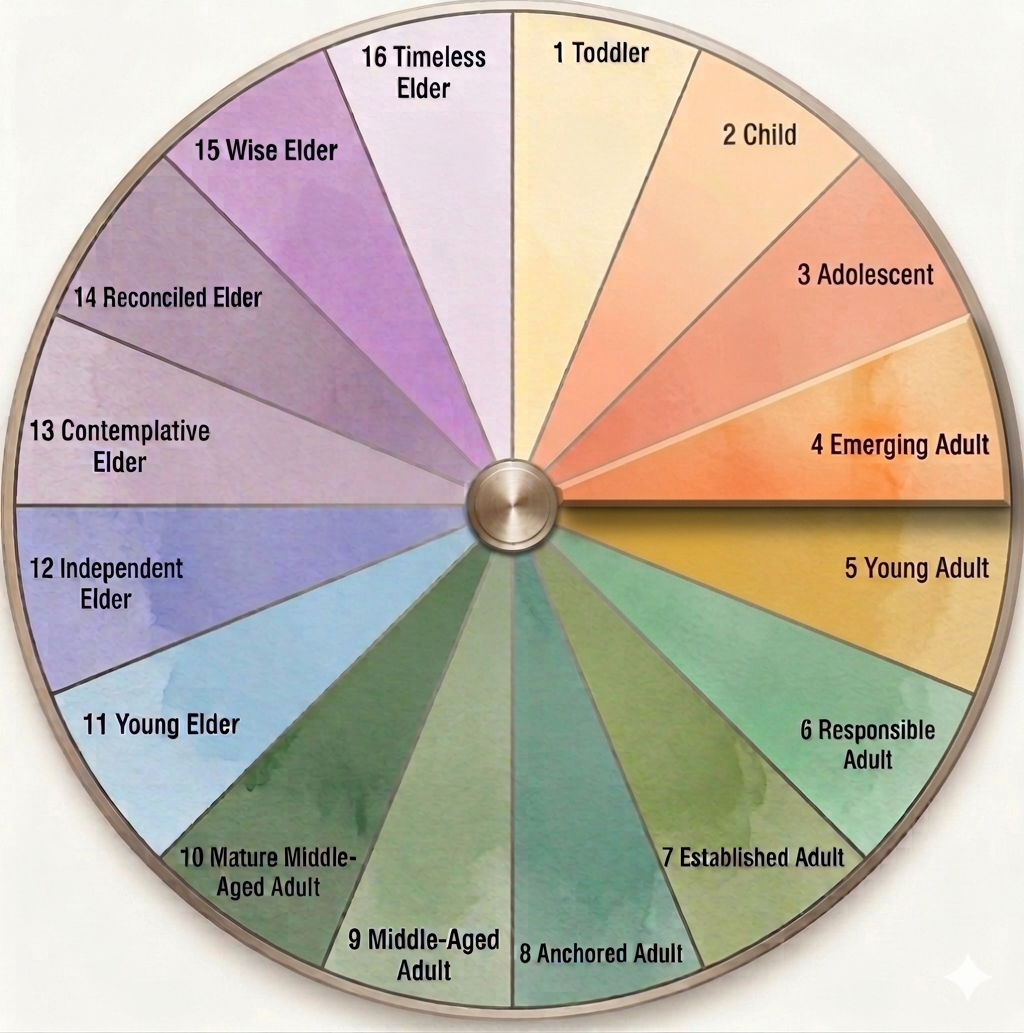
In 2000, the developmental psychologist Jeffrey Arnett proposed the term emerging adulthood to describe a newly distinct developmental stage, one that has become recognisable across industrialised societies precisely because the traditional markers of adulthood (financial independence, leaving home, committed partnership, parenthood) are being reached significantly later than in previous generations. This is not a failure of ambition or a collapse of values. It is a structural shift, driven by the extension of education, changed labour markets, rising housing costs, and evolving social norms around relationships and self-development.
The emerging adult is neither adolescent nor fully adult. They are something genuinely different, characterised by exploration, instability, self-focus, a sense of possibility, and the feeling of being in between.
Physical Peak: The Body at Its Best
Physically, the 19–24 age range represents the peak of human biological capacity. Strength, speed, cardiovascular efficiency, immune function, and recovery ability are all at or near their lifetime maximum. Professional athletes typically peak in their early-to-mid twenties for most sports requiring a combination of speed, strength, and endurance.
Mental processing speed also reaches its peak during this period. The raw speed of information processing, working memory capacity, and perceptual accuracy are higher now than they will be at any other time of life. This physical and cognitive peak is frequently squandered in the haze of late nights, alcohol, poor diet, and disrupted sleep that characterises much of young adult life, which is partly why the potential of this stage often goes unrealised, and partly why the body's resilience allows recovery from the same.
The brain is not yet finished. The prefrontal cortex, the seat of executive function, risk assessment, impulse control, and long-term planning, typically does not reach full maturity until the mid-to-late twenties. This means that the most physically capable version of a human being is running on a regulatory system that is still under construction. The combination produces both the extraordinary energy and the sometimes alarming risk-taking that characterise this period.
Psychological Development: The Quest for Independence
The emerging adult years are characterised by a fundamental psychological drive: the consolidation of autonomy. The identity questions of adolescence, who am I? what do I believe?, are still being answered, but with growing urgency. The emerging adult must now begin making consequential choices: what to study, what career to pursue, where to live, who to spend time with, what values to live by in practice rather than in theory.
Impulsivity decreases relative to adolescence as the prefrontal cortex matures. The emerging adult is beginning to develop the capacity to delay gratification, to tolerate ambiguity, and to think in longer time horizons. But these capacities are still developing, and the emotional intensity of this period, the first loves and heartbreaks, the first experience of genuine professional failure, the first real grief, can still overwhelm regulatory capacity.
Boundary-testing continues, though the terrain shifts. Where the adolescent tests the limits of parental authority, the emerging adult tests the limits of institutions, social conventions, and their own previous assumptions. This is healthy. It is how belief systems are genuinely adopted rather than merely inherited, and how values are owned rather than simply professed.
Delayed Adulthood: A Structural Reality
Across Europe, the average age at which young people leave the parental home varies dramatically by region, from the early twenties in Nordic countries to the early thirties in southern European nations. EU data consistently shows that young adults in the 22–32 age range are leaving home later than their parents did, and often returning after periods of independent living. This "boomerang" pattern is now statistically unremarkable.
The average age at first marriage has also risen steadily across OECD nations, now typically in the late twenties or early thirties. First parenthood is increasingly delayed to the thirties. Financial independence, complicated by rising housing costs, precarious employment, and student debt, often comes later than previous generations expected, even for highly educated young people.
Delayed Milestones Are Not Failure
There is a tendency, particularly from older generations, to interpret delayed adulthood as evidence of immaturity, entitlement, or excessive dependence. The evidence does not support this reading. The extension of emerging adulthood is a rational response to changed structural conditions: the cost of housing, the length of education required for economic stability, the increased complexity of partner selection in a diversified society. Young adults who take longer to commit to careers, partners, and independent living are frequently making more considered choices. Research consistently shows that later marriage, for instance, is associated with greater marital stability. The question is not "why won't they grow up?" but "what does growing up look like now?"
Relationships: The Online Dating Era
The way emerging adults meet and pursue romantic partners has been fundamentally reshaped by digital technology. Online dating has become the primary venue through which adults meet partners, surpassing introductions through friends, workplaces, or social settings for the first time in history. This shift carries both benefits and complications.
The benefits are real: online dating offers access to a vastly larger pool of potential partners than any single social network could provide, and allows for filtering on compatibility before investment of time and emotional energy. The complications are also real: the abundance of options can create what psychologists call the "paradox of choice," where more options produces not more satisfaction but more anxiety and less commitment. When another potential partner is always a swipe away, the impulse to commit to anyone in particular is harder to sustain. Research suggests that online dating, while expanding access to partners, may also be associated with later commitment and higher rates of serial dating without long-term intention.
The Central Question of Emerging Adulthood
The psychologist William Damon has argued that the central developmental challenge of emerging adulthood is the discovery of purpose: a stable, forward-pointing commitment to something beyond the self that gives direction to choices and meaning to effort. This is different from identity (who I am) and different from passion (what excites me today). Purpose is what I will build my life around. It is what I will still be doing, in some form, when the first excitement has faded and the work becomes hard.
Not all emerging adults find purpose in this stage, and those who do not are not failed. Purpose continues to be available at every subsequent stage of life. Those who enter their late twenties with at least a provisional sense of what they are for, some domain of contribution, some relationship of depth, some set of values lived rather than merely aspired to, tend to navigate the demands of the next stage, Summer, with greater stability and satisfaction.
The question the emerging adult is really being asked, by circumstances, by relationships, by the passing of time, is this: What will you commit to? Not everything. Not yet. But something meaningful. Something worth your one life.