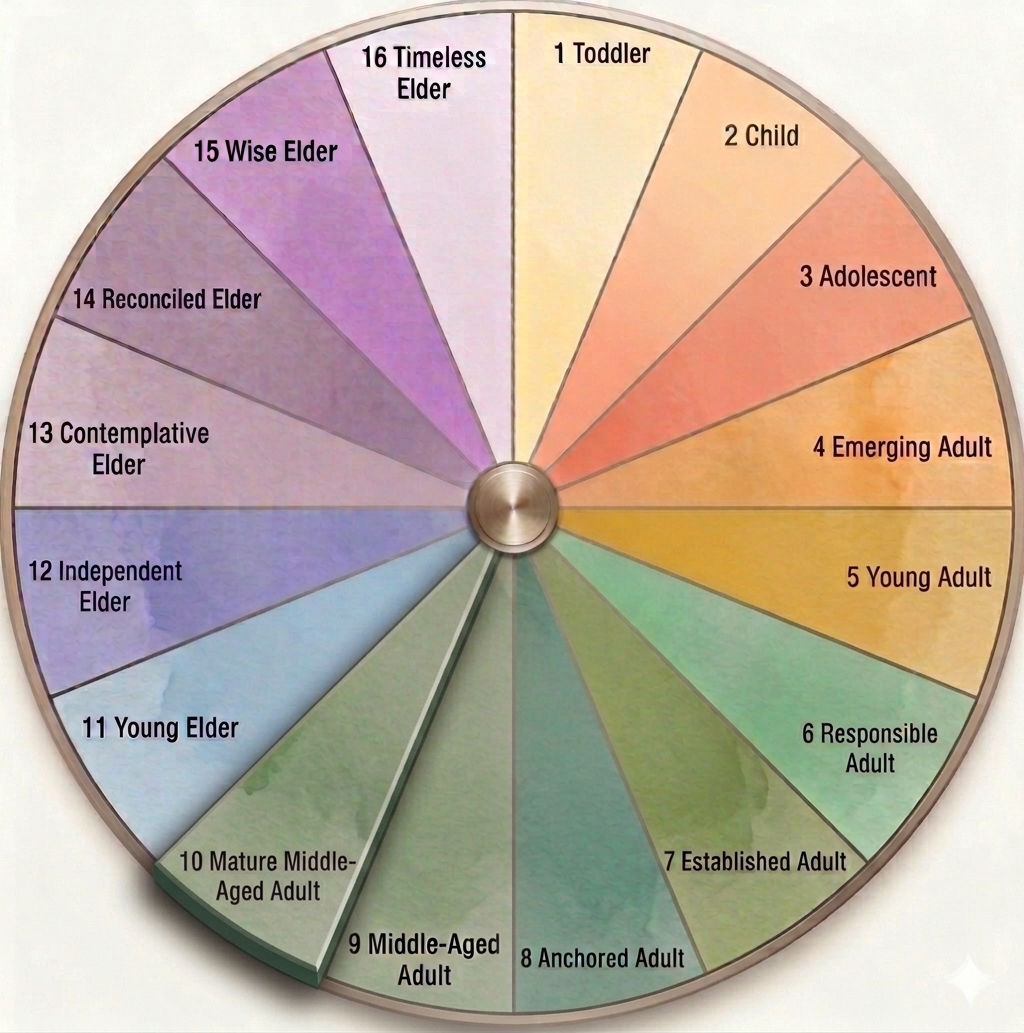
After the Dip: Renewed Ground
If the 49–54 blob is the opening of Autumn, the first confrontation with mortality, restructuring, and what no longer fits, then the 55–60 blob is something different: the beginning of a new stability, earned rather than inherited. The acute turbulence of midlife tends to soften. What emerges in its place is not complacency but a kind of purposeful clarity, a willingness to live more deliberately, on terms one has actually chosen.
Daniel Levinson, whose adult development research remains among the most detailed we have, described this period as the "Late Adulthood Transition," a fundamental reorientation of identity away from the roles and structures that defined the middle decades. The question is no longer "how do I succeed within this life?" but "what kind of life do I actually want, now that I know who I am?"
Redefining Identity Beyond Work
For many people, work has been the primary organising structure of adult identity for three decades or more. The 55–60 blob is often when that structure begins to loosen, whether through choice, redundancy, health changes, or simply the growing awareness that retirement is no longer abstract. That loosening is disorienting for some and liberating for others, and frequently both at once.
The FIRE movement (Financial Independence, Retire Early) has gained significant traction in this decade, particularly among those who built careers in finance, technology, or professional services. For others, "retirement" means phased reduction rather than full stop: consulting arrangements, portfolio careers, or trading institutional employment for self-directed work. The old binary of "working" versus "retired" fits fewer and fewer people's actual experience.
The Grey Divorce Wave
One in four divorces today involves someone aged 50 or older, a figure that has roughly doubled since the 1990s. The drivers are complex: longer life expectancy making a mismatched marriage feel less finite, women's greater financial independence, the empty nest removing a shared organising project, and a cultural shift toward prioritising personal fulfilment at any age. Grey divorce carries specific financial risks, particularly for women, since retirement savings built jointly must now stretch two households. It also comes with unexpected freedoms: many people report that life post-grey divorce, while initially destabilising, leads in time to greater authenticity.
Shifting Gender Roles
One of the more striking findings in adult development research is the gender convergence that tends to occur in the late 50s. Men in this period frequently become more passive, gentle, and emotionally expressive, less driven by competitive achievement, more interested in connection, meaning, and the interior life. Women, by contrast, often become more active, assertive, and outwardly directed, taking on leadership roles, speaking more directly, and pursuing projects they deferred during the years of intensive caregiving.
This convergence is not universal, but it is consistent enough across cultures to suggest something developmental rather than merely generational. It is as if the hormonal and social pressures that pushed men and women into divergent modes for several decades begin to relax, allowing a more integrated selfhood to emerge.
Relationships in Transition
The relationship with adult children often undergoes a welcome maturation in this blob. The parenting relationship, necessarily asymmetrical for decades, gradually reconfigures into something more mutual. Adult children who are now in their 20s and 30s become genuine peers in some respects: people with whom conversation can be honest, disagreement can be respectful, and care can flow in both directions.
At the same time, the caregiving burden for ageing parents increases sharply in this decade. Sandwich generation pressures, caught between the needs of the younger generation and the older one, reach their peak for many people in their late 50s. This is emotionally and logistically demanding, and it falls disproportionately on women, who continue to provide the majority of informal elder care.
The Physical and Mental Picture
The physical changes of the late 50s are real and measurable. Brain volume loss, which begins gradually in the 40s, accelerates somewhat in this decade. Vision, particularly close-focus reading vision, typically requires correction. Hearing decline, though often gradual, becomes more noticeable. Sleep architecture shifts, bringing lighter sleep, earlier waking, and reduced deep sleep, with downstream effects on energy and mood.
But cognitive deterioration is not the dominant story. Pattern recognition and wisdom with familiar information, the ability to navigate complex, ambiguous situations using deeply encoded experience, continue to strengthen. The mind that cannot learn new things as quickly as it once did is often the same mind that can read a room, assess a person, or solve a familiar problem with breathtaking economy. The nature of intelligence shifts. The quantity does not necessarily diminish.
The Career Question
The 55–60 blob is often when career decisions take on unusual weight. Retraining for a second career is possible but requires genuine commitment and realistic expectations about the timeline. Consulting, trading institutional employment for project-based expertise work, suits many experienced professionals but demands a tolerance for uncertainty that not everyone has cultivated. Portfolio careers, combining part-time paid work with advisory roles and purposeful projects, are increasingly the reality rather than the exception.
Whatever the arrangement, the research is consistent: staying engaged, intellectually, socially, purposefully, in the late 50s significantly predicts both cognitive health and life satisfaction in the decades that follow.