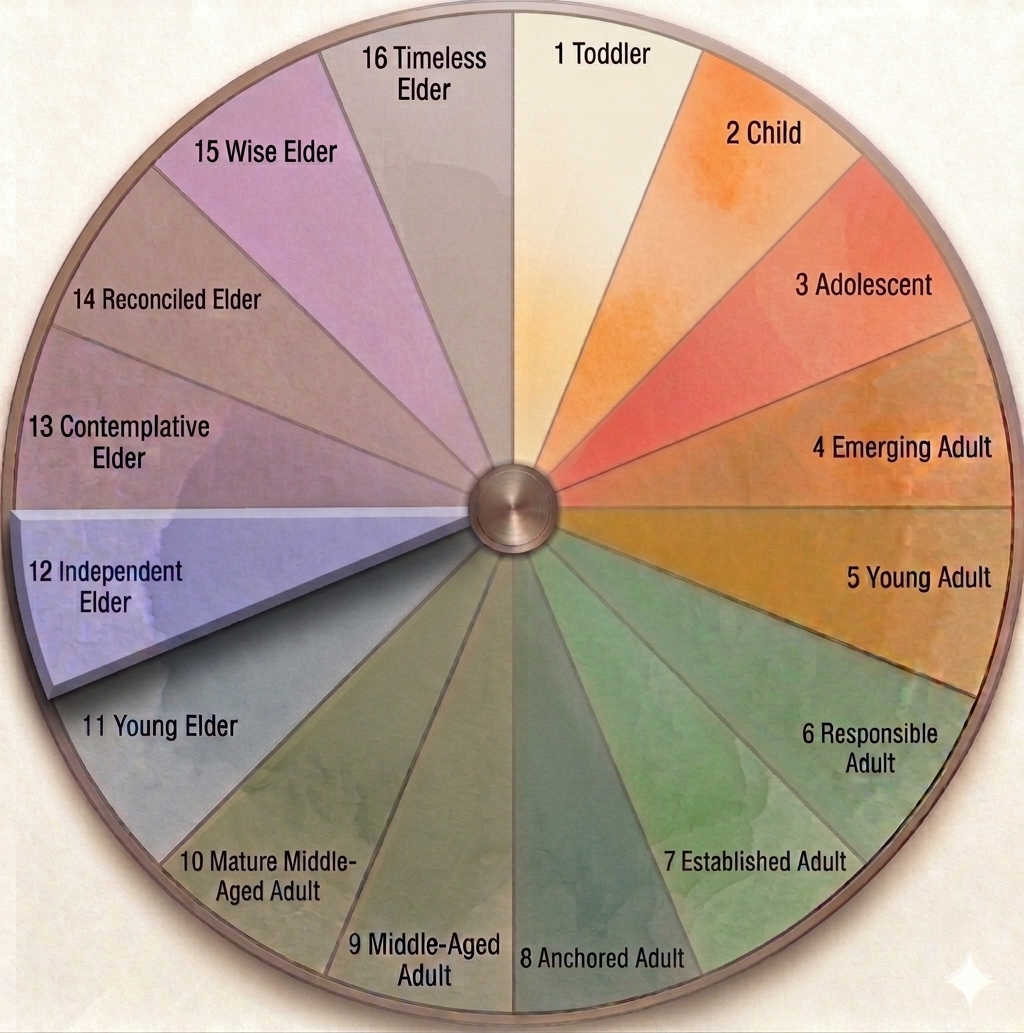
The Major Transition
For most people, the 67–72 blob involves the most significant structural change since entering the workforce: full retirement, or a decisive shift to self-employment or project-based work that removes the last traces of institutional schedule and obligation. The impact of this change is routinely underestimated, not because it is bad, but because the loss of structure turns out to be a more fundamental disruption than the loss of income.
Around 40% of retirees report an initial period of genuine struggle with adjustment. This is not depression, in most cases, but disorientation: the daily architecture of a life, a reason to be somewhere at a particular time, a role, a team, a set of problems that belong to you, simply disappears. The adjustment is not about filling time. It is about reconstructing a sense of purpose and identity that was previously embedded in the work structure itself.
The Structure Problem
Losing work is not primarily about losing income. It is about losing structure. Work provides time architecture, social contact, identity, status, and a sense of purpose simultaneously. When it ends, all five disappear at once. Research consistently shows that retirees who actively construct new structures, regular commitments, social roles, purposeful projects, adapt significantly better than those who approach retirement as open-ended freedom. The goal is not to replicate work, but to replace its functions deliberately.
Relationships Renegotiated
Retirement changes the domestic landscape profoundly, particularly for couples. Partners who have spent forty years sharing a home while largely living separate daily lives, different workplaces, different schedules, different social worlds, suddenly find themselves sharing that home for most of the waking day. The research is clear: this requires active renegotiation. Couples who navigate this transition well tend to be explicit about it, discussing expectations, space, independence, and shared goals rather than assuming the relationship will simply absorb the change.
For those who did not make this transition well: divorce among the over-60 age group has tripled since 1990. Some of this reflects the grey divorce wave described in earlier blobs. Some of it reflects the specific pressure of sudden shared proximity without adequate renegotiation. The couples who flourish in retirement are typically those who treat it as a new chapter with new terms, rather than a continuation of the previous arrangement.
Money After Work
Financial life in retirement involves a genuine restructuring of spending. Some costs fall, commuting and professional memberships, primarily. Others rise, often unexpectedly: healthcare and home adaptation. Adults over 60 are now the fastest-growing demographic in travel spending globally, driven by accumulated savings and a shift in priorities toward experience over acquisition.
The financial complexity of this stage is often underappreciated. Managing drawdown from pension savings, navigating healthcare costs, and planning for the possibility of future care needs requires the kind of long-horizon financial thinking that, as noted in the earlier blob, typically peaks in the early 50s. Engaging a trusted financial adviser in this decade, if not earlier, is not a luxury but a practical necessity for most people.
Social Life and Solitude
Approximately 40% of people over 65 live alone, a figure that reflects both the high rate of widowhood and the grey divorce wave, as well as the simple demographic reality that women outlive men by an average of five to seven years in most developed countries. Living alone is not the same as being lonely, but the risk of social isolation increases substantially without active management.
For many people in this blob, friendships become more central than at any point since early adulthood. The voluntary quality of these relationships, maintained entirely by mutual choice rather than institutional proximity, gives them a particular character. People in their late 60s and early 70s who report strong friendships consistently show better health outcomes, better cognitive trajectories, and higher life satisfaction than those who are more socially isolated, regardless of their physical health status.
Volunteering, advisory roles, trustee positions, community board memberships, and neighbourhood-scale civic involvement all represent effective purpose vehicles at this stage, combining social connection, meaningful contribution, and cognitive engagement in a single activity.
The Body at 67–72
Physical changes in this blob are real and gradual. Skin elasticity continues to decline. Joint flexibility reduces, particularly in the hips, knees, and spine. Reaction times slow measurably, which has practical implications for driving safety that deserve honest assessment rather than denial. Bone density loss, particularly in women, increases the risk and severity of fractures.
But "physical decline" is not the whole story. People who have maintained consistent physical activity through their 60s carry a significant advantage: the gap between the active and sedentary at 70 is vastly larger than the gap at 50. The returns on movement, in whatever form suits the individual, are higher in this decade than at almost any earlier point. The difference between a 70-year-old who moves regularly and one who does not is not marginal. It is profound.
Integrity vs. Despair: The Life Review
Erik Erikson placed the final developmental stage, Integrity vs. Despair, in late adulthood, and it finds its first full expression in this blob. The developmental task is one of retrospective meaning-making: can I look at the life I have actually lived, including its disappointments, compromises, failures, and losses, and find in it something coherent, something worth having been? Or does the reckoning produce primarily regret and bitterness?
This is not a passive process. The "life review," whether formal or informal, written or spoken, solitary or shared, is a genuine developmental task, and engaging it thoughtfully produces measurably better outcomes than avoiding it. Memoir writing is one of the most direct vehicles for this work. The goal is not to rewrite the past but to make peace with it, and in doing so, to free the present for the purposeful, engaged living that this stage makes genuinely possible.